Advertisements
Advertisements
प्रश्न
A concave mirror forms a virtual image of size twice that of the object placed at a distance 5 cm from it. Find:
- the focal length of the mirror
- position of image
Advertisements
उत्तर
Given: Object distance, u = −5 cm (object is in front of the mirror)
The image is virtual and erect
Magnification, m = +2m
(a) m = `-v/u`
∴ `-v/u = 2`
∴ −v = 2u
∴ −v = 2 × −5
∴ v = 10 cm
Hence, the image is 10 cm behind the mirror.
(b) From the mirror formula,
`1/f = 1/v + 1/u`
∴ `1/f = 1/10 + 1/(-5)`
= `1/10 - 1/5`
∴ f = −10 cm
APPEARS IN
संबंधित प्रश्न
Explain the following term related to spherical lenses:- principal focus
When a spherical mirror is held towards the sun and its sharp image is formed on a piece of a carbon paper for some time, a hole is burnt in the carbon paper.
Why is a hole burnt in the carbon paper?
Explain the following term:
Incident ray
Draw diagram/diagrams to show them.
State the two convenient rays that are chosen to construct the image by a spherical mirror for a given object? Explain your answer with the help of suitable ray diagrams.
State two uses of a concave mirror.
Upto what maximum distance from the pole the image in a convex mirror can be obtained? what will be the location of object then ?
Define the following term in relation to concave mirror.
Pole
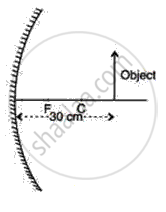
An object is placed in front of a concave mirror as shown in the following figure. By scale drawing, find the nature of the image. Given f = 10 cm, v = 30 cm.
Spherical mirrors are one form of ______ mirrors.
