Advertisements
Advertisements
प्रश्न
A virtual image larger than the object can be produced by a ______.
पर्याय
concave lens
concave mirror
convex mirror
plane mirror
Advertisements
उत्तर
A virtual image larger than the object can be produced by a concave mirror.
Explanation:
The concave lens and convex mirror form a virtual but diminished image of the object, while the plane mirror forms a virtual but same-size image of the object.
APPEARS IN
संबंधित प्रश्न
What kind of mirror is required for obtaining a virtual image of the same size as the object?
What is the name of the phenomenon in which the right side of an object appears to be the left side of the image in a plane mirror?
Complete the following diagrams shown in Fig. by drawing the reflected ray for each of the incident ray A and B.
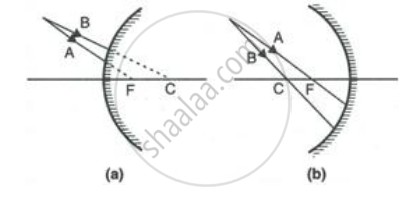
A concave mirror forms a virtual image of size twice that of the object placed at a distance 5 cm from it. Find:
- the focal length of the mirror
- position of image
The spherical mirror used as a rear view mirror in the vehicle is
The spherical mirror used in a beauty parlour as make-up mirror is _______.
Numerical problem.
The radius of curvature of a spherical mirror is 25 cm. Find its focal length.
If the real image of a candle flame formed by a lens is three times the size of the flame and the distance between lens and image is 80 cm, at what distance should the candle be placed from the lens?
Define the radius of curvature.
