Advertisements
Advertisements
Question
A virtual image larger than the object can be produced by a ______.
Options
concave lens
concave mirror
convex mirror
plane mirror
Advertisements
Solution
A virtual image larger than the object can be produced by a concave mirror.
Explanation:
The concave lens and convex mirror form a virtual but diminished image of the object, while the plane mirror forms a virtual but same-size image of the object.
APPEARS IN
RELATED QUESTIONS
An image formed by a ______ mirror is always of the same size as that of the object.
Find out the letters of English alphabet or any other language known to you in which the image formed in a plane mirror appears exactly like the letter itself. Discuss your findings.
Name the spherical mirror which can produce a virtual and diminished image of an object.
How is a spherical mirror used to diverge a beam of light from a point? Name the type of mirror used.
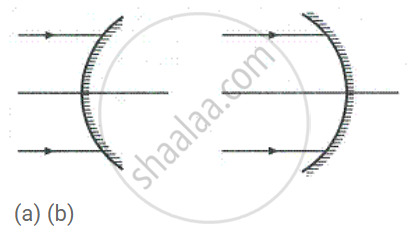
Name the mirrors shown in Figure (a) and (b).
An object 5 cm high forms a virtual image of 1.25 cm high, when placed in front of a convex mirror at a distance of 24 cm. Calculate:
- the position of the image
- the focal length of the convex mirror.
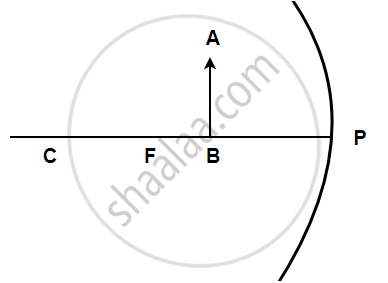
In the following figure shows a concave mirror with its pole (P), focus (F) and centre of curvature (C). Draw a ray diagram to show the formation of the image of an object AB by the concave mirror.
The spherical mirror used in a beauty parlour as make-up mirror is _______.
Size of image of an object by a mirror having a focal length of 20 cm is observed to be reduced to 1/3rd of its size. At what distance the object has been placed from the mirror? What is the nature of the image and the mirror?
