Advertisements
Advertisements
Question
Advertisements
Solution
APPEARS IN
RELATED QUESTIONS
One half of a convex lens of focal length 10 cm is covered with a black paper. Can such a lens produce an image of a complete object placed at a distance of 30 cm from the lens? Draw a ray diagram to justify your answer. A 4 cm tall object is placed perpendicular to its principal axis of a convex lens of focal length 20 cm. The distance of the object from the lens is 15 cm. Find the nature, position and the size of the image.
A concave mirror always forms a real image.
Define the following terms in the context of spherical mirrors :
(i) Pole
(ii) Centre of curvature
(iii) Radius of curvature
(iv) Principal axis
Name the mirror which always produces an erect and virtual image. How is the size of image related to the size of object?
Draw a ray diagram to show the formation of image of an object kept in front of a convex mirror. State three characteristics of the image.
An object of height 2 cm is placed at a distance of 20 cm in front of a concave mirror of a focal length of 12 cm. Find the position, size, and nature of the image.
The sun is seen before the sunrise and after the sunset.
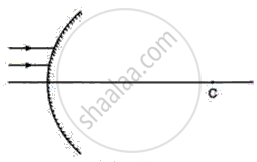
The diagram below shows the parallel rays incident on a convex mirror. C is the centre of the curvature of the mirror. By drawing the paths of the reflected rays, label the focus F and hence find the focal length of the mirror.
The distance from the center of curvature of the mirror to the pole is called the focal length of the mirror.
