Advertisements
Advertisements
Question
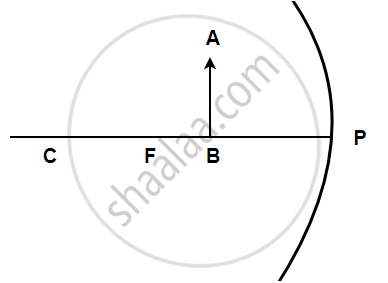
In the following figure shows a concave mirror with its pole (P), focus (F) and centre of curvature (C). Draw a ray diagram to show the formation of the image of an object AB by the concave mirror.
Advertisements
Solution
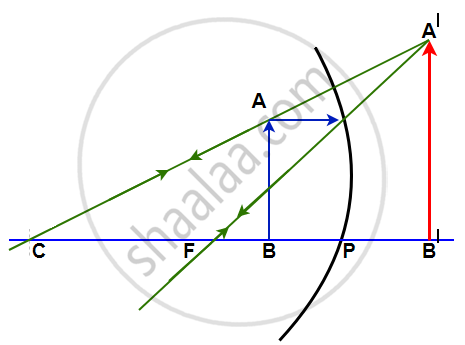
A light ray, parallel to the principal axis, coming from a point on object AB is reflected from the surface of the mirror, it passes through the principal focus and the other ray striking normally to the mirror reflects back and passes through the center of curvature. These two reflected rays, when produced backward, coincide at a point where the image is formed. The image, A'B' is virtual, erect, and magnified in size.
APPEARS IN
RELATED QUESTIONS
State the two kinds of spherical mirror and distinguish them with the aid of proper diagrams.
Explain the following terms :
Pole, Centre of curvature, Radius of curvature, Principal axis. Show them on separate diagrams for each of the concave and convex mirrors.
What is a spherical mirror?
State the kind of mirror used
(a) By a dentist,
(b) As a search-light reflector.
Select the correct option:
Which mirror is used in periscope?
Define the term principal focus in case of convex mirror. Draw a convex mirror and show its principal focus and focal length clearly.
Define linear magnification produced by a mirror?
Define the term Focus of a concave mirror.
The minimum length of the mirror required to see the full image of the person is half ‘ of his height.
