Advertisements
Advertisements
प्रश्न
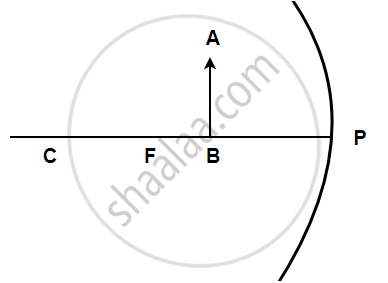
In the following figure shows a concave mirror with its pole (P), focus (F) and centre of curvature (C). Draw a ray diagram to show the formation of the image of an object AB by the concave mirror.
Advertisements
उत्तर
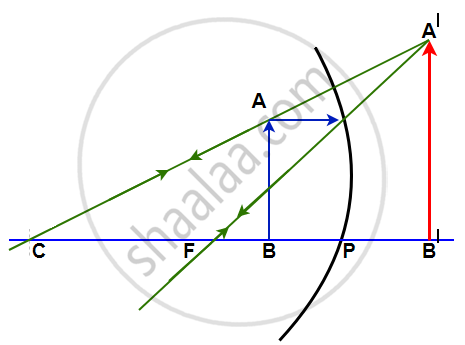
A light ray, parallel to the principal axis, coming from a point on object AB is reflected from the surface of the mirror, it passes through the principal focus and the other ray striking normally to the mirror reflects back and passes through the center of curvature. These two reflected rays, when produced backward, coincide at a point where the image is formed. The image, A'B' is virtual, erect, and magnified in size.
APPEARS IN
संबंधित प्रश्न
When a spherical mirror is held towards the sun and its sharp image is formed on a piece of a carbon paper for some time, a hole is burnt in the carbon paper.
What name is given to the distance between spherical mirror and carbon paper?
How is a spherical mirror used to diverge a beam of light from a point? Name the type of mirror used.
Draw separate diagram for the formation of virtual image of an object by a concave mirror.
Name the kind of mirror used to obtain:
A virtual and enlarged image
The spherical mirror with a reflecting surface curved inward is called
Spherical mirrors are one form of ______ mirrors.
The minimum length of the mirror required to see the full image of the person is half ‘ of his height.
