Advertisements
Advertisements
प्रश्न
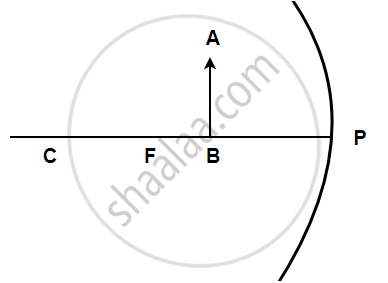
In the following figure shows a concave mirror with its pole (P), focus (F) and centre of curvature (C). Draw a ray diagram to show the formation of the image of an object AB by the concave mirror.
Advertisements
उत्तर
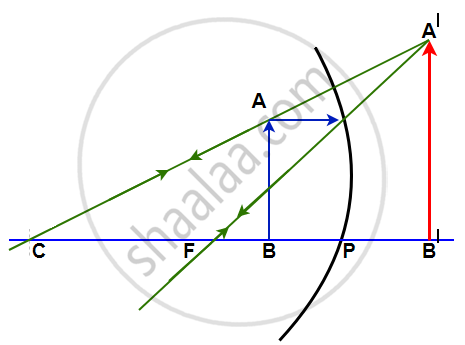
A light ray, parallel to the principal axis, coming from a point on object AB is reflected from the surface of the mirror, it passes through the principal focus and the other ray striking normally to the mirror reflects back and passes through the center of curvature. These two reflected rays, when produced backward, coincide at a point where the image is formed. The image, A'B' is virtual, erect, and magnified in size.
APPEARS IN
संबंधित प्रश्न
Define the Focal length of a spherical mirror
AB and CD, two spherical mirrors, from parts of a hollow spherical ball with its centre at O as shown in the diagram. If arc AB = `1/2` arc CD, what is the ratio of their focal lengths? State which of the two mirrors will always form virtual image of an object placed in front of it and why.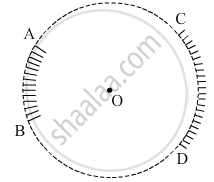
Name the two kinds of spherical mirrors and distinguish between them.
Discuss the position and nature of image formed by a concave mirror when an object is moved from infinity towards the pole of mirror.
What is meant by magnification? Write its expression. What is its sign for the (a) real (b) virtual, image?
State two uses of a concave mirror.
A concave mirror forms a real image of an object placed in front of it at a distance 30 cm, of size three times the size of object. Find
- the focal length of mirror
- position of image.
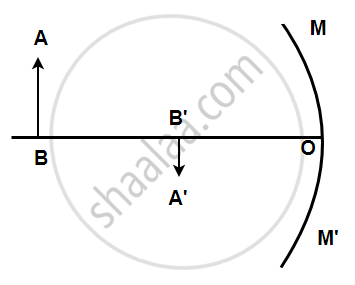
AB is the object, A'B' is the image, and MM' is the position of the mirror. Complete the ray diagram showing the formation of the image and find the focal length of the mirror.
Define the radius of curvature.
