Advertisements
Advertisements
प्रश्न
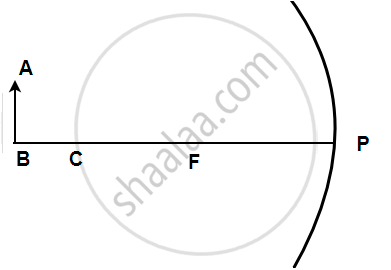
The following figure shows a concave mirror with its pole (P), focus (F), and center of curvature (C). Draw a ray diagram to show the formation of the image of an object AB by the concave mirror.
Advertisements
उत्तर

A light ray, parallel to the principal axis, coming from a point on object AB is reflected from the surface of the mirror, it passes through the principal focus and the other ray passing through the center of curvature strikes the mirror normally i.e. 90 degrees. Hence it will reflect back. These two reflected rays coincide at a point between F and C, where the image is formed. The image, A'B' is real, inverted, and diminished in size.
APPEARS IN
संबंधित प्रश्न
Define the following term in the context of spherical mirrors:- Pole
When a spherical mirror is held towards the sun and its sharp image is formed on a piece of a carbon paper for some time, a hole is burnt in the carbon paper.
What is the advantage of using a carbon paper rather than a white paper?
If a spherical mirror breaks, what type of mirrors are the individual pieces?
Does the mirror mentioned in part (b) form real image for all locations of the object?
Write the spherical mirror's formula and explain the meaning of each symbol used in it.
The radius of curvature of a convex mirror is 40 cm. Find its focal length.
What is the focal length (f) of a mirror?
