Advertisements
Advertisements
प्रश्न
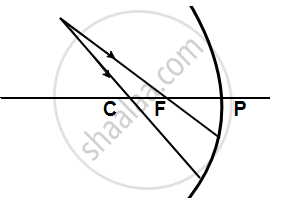
Complete the following diagrams shown in the below figure by drawing the reflected ray for each incident ray.
Advertisements
उत्तर
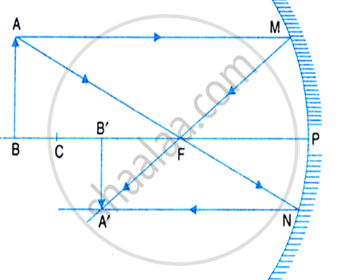
A light ray coming from a point on object AB passes through the principal focus and after reflection, it becomes parallel to the principal axis in accordance with laws of reflection and the other ray passing through the centre of curvature strikes the mirror normally i.e. 90 degrees. Hence it will reflect back. These two reflected rays coincide at a point where the image is formed. The image, A'B' is real, inverted, and diminished in size.
APPEARS IN
संबंधित प्रश्न
Match the items given in Column I with one or more items of Column II.
| Column I | Column II | ||
| (a) | A plane mirror | (i) | Used as a magnifying glass. |
| (b) | A convex mirror | (ii) | Can form image of objects spread over a large area. |
| (c) | A convex lens | (iii) | Used by dentists to see enlarged image of teeth. |
| (d) | A concave mirror | (iv) | The image is always inverted and magnified. |
| (e) | A concave lens | (v) | The image is erect and of the same size as the object. |
| (vi) | The image is erect and smaller in size than the object. |
What type of image is formed:
on a cinema screen?
Write the formula for a lens connecting image distance (v), object distance (u) and the focal length (f). How does the lens formula differ from the mirror formula?
What do you mean by the term dispersion?
Discuss the position and nature of image formed by a concave mirror when an object is moved from infinity towards the pole of mirror.
Name the kind of mirror used to obtain:
A real and diminished image.
Which mirror will you prefer to use as a rear view mirror in a car : plane mirror or convex mirror? Give one reason.
(a) When a concave mirror is used as a shaving mirror, where is the person's face in relation to the focus of mirror?
(b) State three characteristics of the image seen in part (a).
An object 5 cm high is placed at a distance 60 cm in front of a concave mirror of focal length 10 cm. Find the position and size of the image.
The image formed in a plane mirror is always inverted.
