Advertisements
Advertisements
प्रश्न
A student obtained a sharp image of a burning candle, placed at the farther end of a laboratory table, on a screen using a concave mirror. For getting better value of focal length of the mirror, the subject teacher suggested him for focusing a well illuminated distant object. What should the student do?
(A) He should move the mirror away from the screen.
(B) He should move the mirror slightly towards the screen.
(C) He should move the mirror as well as the screen towards the newly selected object.
(D) He should move only the screen towards the newly selected object.
Advertisements
उत्तर
(B)
As the image distance is increased, the object distance would decrease and thus the mirror-screen distance should be decreased. Therefore, the mirror should be moved towards the screen.
APPEARS IN
संबंधित प्रश्न
A 4 cm tall object is placed on the principal axis of a convex lens. The distance of the object from the optical centre of the lens is 12 cm and its sharp image is formed at a distance of 24 cm from it on a screen on the other side of the lens. If the object is now moved a little away from the lens, in which way (towards the lens or away from the lens) will he have to move the screen to get a sharp image of the object on it again? How will the magnification of the image be affected?
Define Radius of curvature of the spherical mirror
When a spherical mirror is held towards the sun and its sharp image is formed on a piece of a carbon paper for some time, a hole is burnt in the carbon paper.
At which point of the spherical mirror the carbon paper is placed?
A 2.0 cm tall object is placed 40 cm from a diverging lens of focal length 15 cm. Find the position and size of the image.
Name the two kinds of spherical mirrors and distinguish between them.
Complete the following diagrams in Figure by drawing the reflected rays for the incident rays 1 and 2.
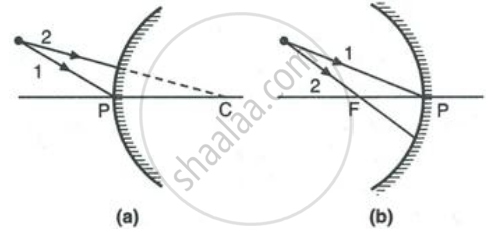
Name the kind of mirror used to obtain:
A virtual and diminished image
Draw a ray diagram to show the formation of the image, when the object is placed between optical centre and principal focus of a convex lens.
State the signs and values of magnifications in the above mentioned case.
What is the relation between focal length and radius of curvature of a concave mirror?
Geometric centre of the spherical mirror is ______.
