Advertisements
Advertisements
Question
A student obtained a sharp image of a burning candle, placed at the farther end of a laboratory table, on a screen using a concave mirror. For getting better value of focal length of the mirror, the subject teacher suggested him for focusing a well illuminated distant object. What should the student do?
(A) He should move the mirror away from the screen.
(B) He should move the mirror slightly towards the screen.
(C) He should move the mirror as well as the screen towards the newly selected object.
(D) He should move only the screen towards the newly selected object.
Advertisements
Solution
(B)
As the image distance is increased, the object distance would decrease and thus the mirror-screen distance should be decreased. Therefore, the mirror should be moved towards the screen.
APPEARS IN
RELATED QUESTIONS
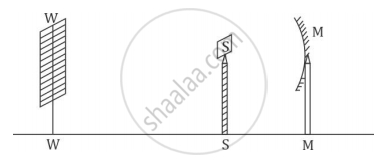
A student obtains a sharp image of the distant window (W) of the school laboratory on the screen (S) using the given concave mirror (M) to determine its focal length. Which of the following distances should he measure to get the focal length of the mirror?
Name the spherical mirror which can produce a virtual and diminished image of an object.
The shiny outer surface of a hollow sphere of aluminium of radius 50 cm is to be used as a mirror:
- What will be the focal length of this mirror?
- Which type of spherical mirror will it provide?
- State whether this spherical mirror will diverge or converge light rays.
A diverging lens is used in ______.
How is a spherical mirror used to diverge a beam of light from a point? Name the type of mirror used.
Draw a ray diagram to show the formation of image by a concave mirror for an object placed between its pole and focus. State three characteristics of the image.
For an incident ray directed towards centre of curvature of a spherical mirror the reflected ray:
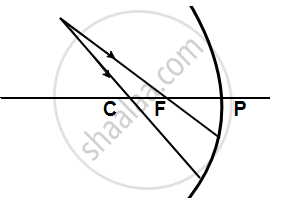
Complete the following diagrams shown in the below figure by drawing the reflected ray for each incident ray.
The distance from the center of curvature of the mirror to the pole is called the focal length of the mirror.
