Advertisements
Advertisements
प्रश्न
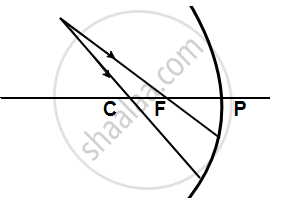
Complete the following diagrams shown in the below figure by drawing the reflected ray for each incident ray.
Advertisements
उत्तर
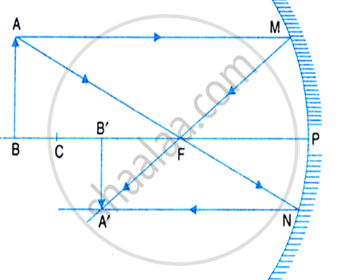
A light ray coming from a point on object AB passes through the principal focus and after reflection, it becomes parallel to the principal axis in accordance with laws of reflection and the other ray passing through the centre of curvature strikes the mirror normally i.e. 90 degrees. Hence it will reflect back. These two reflected rays coincide at a point where the image is formed. The image, A'B' is real, inverted, and diminished in size.
APPEARS IN
संबंधित प्रश्न
Explain the following term related to spherical lenses: focal length
Which type of mirror can form a real image?
Name the two types of spherical mirrors. What type of mirror is represented by the:
- back side of a shining steel spoon?
- front side of a shining steel spoon?
Explain the following terms :
Pole, Centre of curvature, Radius of curvature, Principal axis. Show them on separate diagrams for each of the concave and convex mirrors.
Define linear magnification produced by a mirror?
The spherical mirror used as a rear view mirror in the vehicle is
A ray of light is incident towards a plane mirror at an angle of 30° with the mirror surface. What will be the angle of reflection?
Visit a nearby hospital. You can also visit the clinic of an ENT specialist, or a dentist. Request the doctor to show you the mirrors used for examining ear, nose, throat and teeth. Can you recognise the kind of mirror used in these instruments?
