Advertisements
Advertisements
Question
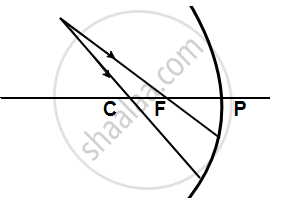
Complete the following diagrams shown in the below figure by drawing the reflected ray for each incident ray.
Advertisements
Solution
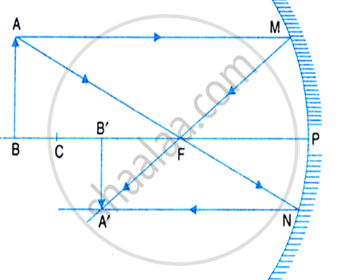
A light ray coming from a point on object AB passes through the principal focus and after reflection, it becomes parallel to the principal axis in accordance with laws of reflection and the other ray passing through the centre of curvature strikes the mirror normally i.e. 90 degrees. Hence it will reflect back. These two reflected rays coincide at a point where the image is formed. The image, A'B' is real, inverted, and diminished in size.
APPEARS IN
RELATED QUESTIONS
Name the spherical mirror which can produce a virtual and diminished image of an object.
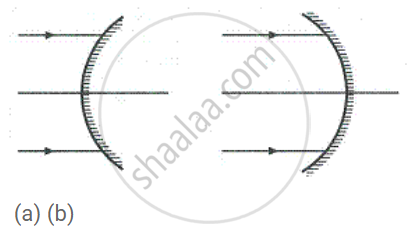
In each case (a) and (b), draw reflected rays for the given incident rays and mark focus by the symbol F.
Discuss the position and nature of image formed by a concave mirror when an object is moved from infinity towards the pole of mirror.
Name the kind of mirror used to obtain :
A real and enlarged image
Why does a driver use a convex mirror instead of a plane mirror as a rear view mirror?
Illustrate your answer with the help of a ray diagram.
When an object of height 1 cm is kept at a distance 4 cm from a concave mirror, its erect image of height 1.5 cm is formed at a distance 6 cm behind the mirror. Find the focal length of mirror, by drawing.
Is real image always inverted?
Define linear magnification produced by a mirror?
What is the difference between virtual images of an object formed by a concave mirror and a convex mirror?
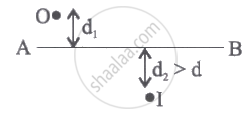
In the figure shown, the image of a real object is formed at the point I. AB is the principal axis of the mirror. The mirror must be: