Advertisements
Advertisements
Question
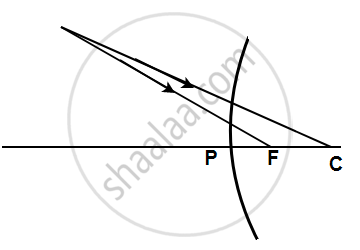
Complete the following diagrams shown in the below figure by drawing the reflected ray for each incident ray.
Advertisements
Solution

A light ray when produced backwards passes through principal focus as shown in the problem figure. We draw the normal through the centre of curvature at the point of incidence and draw the reflected ray at an angle equal to the angle of incidence thus following the laws of reflection. The reflected ray is parallel to the principal axis. The other ray is passing through the centre of curvature as shown in the problem figure. This ray retraces its incident path because it strikes the mirror normally i.e. 90 degrees. These two reflected rays when produced backwards coincide at a point where the image is formed. The image, A'B' is virtual, erect, and diminished in size.
APPEARS IN
RELATED QUESTIONS
Define the Focal length of a spherical mirror
What type of image is formed:
on a cinema screen?
State two uses of a concave mirror.
Answer the following question:
Distinguish between the convex mirror and the concave mirror.
The following Figure shows a concave mirror MM' on which a ray of light incident from a point P gets reflected to meet the principle axis at O.
(a) Find, by construction, the position of the centre of curvature of the concave mirror.
(b) Write down the value for the radius of curvature of the mirror.
(c) Calculate the focal length of the mirror.
(d ) Which relation is used in deducing the focal length from the radius of curvature?
The spherical mirror used in a beauty parlour as make-up mirror is _______.
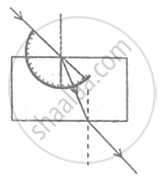
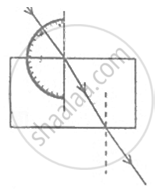
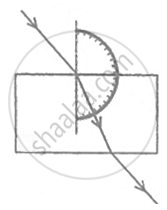
A student traces the path of a ray of light passing through a rectangular slab.
 |
 |
 |
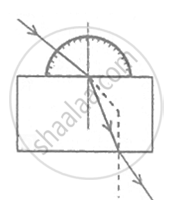 |
For measuring the angle of incidence, he must position the protractor in the manner shown in the figure:
For a spherical mirror, ______ is true.
A spherical mirror whose reflecting surface is curved outwards is called ______ mirror.
