Advertisements
Advertisements
प्रश्न
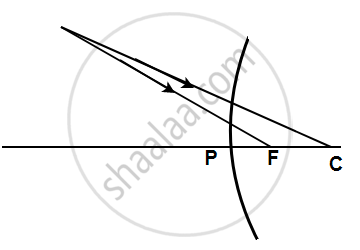
Complete the following diagrams shown in the below figure by drawing the reflected ray for each incident ray.
Advertisements
उत्तर

A light ray when produced backwards passes through principal focus as shown in the problem figure. We draw the normal through the centre of curvature at the point of incidence and draw the reflected ray at an angle equal to the angle of incidence thus following the laws of reflection. The reflected ray is parallel to the principal axis. The other ray is passing through the centre of curvature as shown in the problem figure. This ray retraces its incident path because it strikes the mirror normally i.e. 90 degrees. These two reflected rays when produced backwards coincide at a point where the image is formed. The image, A'B' is virtual, erect, and diminished in size.
APPEARS IN
संबंधित प्रश्न
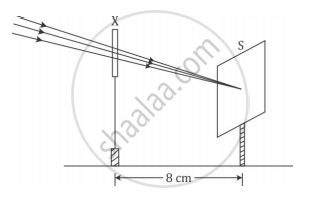
A student used a device (X) to obtain/focus the image of a well illuminated distant building on a screen (S) as shown below in the diagram. Select the correct statement about the device (X).
When a spherical mirror is held towards the sun and its sharp image is formed on a piece of a carbon paper for some time, a hole is burnt in the carbon paper.
At which point of the spherical mirror the carbon paper is placed?
State the number of images of an object placed between two mirrors, formed in each case when mirrors are inclined to each other at (a) 90°, and (b) 60°.
Name the kind of mirror used to obtain:
A virtual and enlarged image
The focal length of a concave mirror is 10 cm. Find its radius of curvature.
An object 10 cm high is placed at a distance of 20 cm in front of a spherical mirror of focal length 25 cm. By scale drawing find the nature, position, and magnification of the image in the following case:
Concave mirror
In torches, search lights and headlights of vehicles the bulb is placed ______.
Size of image of an object by a mirror having a focal length of 20 cm is observed to be reduced to 1/3rd of its size. At what distance the object has been placed from the mirror? What is the nature of the image and the mirror?
Define the radius of curvature.
