Advertisements
Advertisements
प्रश्न
Size of image of an object by a mirror having a focal length of 20 cm is observed to be reduced to 1/3rd of its size. At what distance the object has been placed from the mirror? What is the nature of the image and the mirror?
Advertisements
उत्तर
Case I: (In case of convex mirror)
Magnification, `"m" = 1/3` (convex mirror)
Focal length (f) = 20 cm
Size of image `("h"_"i") = 1/3 xx "h"_"o"` (Size of object)
Using the magnification formula,
`"m" = "h"_"i"/"h"_"o" = (-upsilon)/"u"`
Substituting the values in the above equation,
`("h"_"o"/3)/"h"_"o" = (-upsilon)/"u"`
`1/3 = (-upsilon)/"u"`
`upsilon = (-"u")/3`
Using the mirror formula,
`1/upsilon + 1/"u" = 1/"f"`
`(-3)/"u" + 1/"u" = 1/20`
`(-2)/"u" = 1/20`
u = -40 cm
Negative sign shows that the object is in front of the mirror.
Substituting the above value in obtained image distance and object distance relation,
`upsilon = -u/3 = - ((-40))/3 = 40/3` cm
Thus, the image formed is virtual, erect and diminished. The object is at a distance of 40 cm from the mirror.
Case II: In case of concave mirror
Magnification, `"m" = -1/3` (concave mirror)
Focal length (f) = -20 cm
Using the magnification formula,
`"m" = "h"_"i"/"h"_"o" = (-upsilon)/"u"`
Substituting the values in the above equation,
`(-1)/3 = (-upsilon)/"u"`
`1/3 = upsilon/"u"`
`upsilon = "u"/3`
Using the mirror formula,
`1/upsilon + 1/"u" = 1/"f"`
`3/"u" + 1/"u" = 1/(-20)`
`4/"u" = 1/(-20)`
u = -80 cm
`upsilon = "u"/3 = -80/3` cm
Thus, the image will be real and inverted. The object is at a distance of 80 cm from the mirror.
APPEARS IN
संबंधित प्रश्न
Explain the following term related to spherical lenses:- centres of curvature
A virtual image larger than the object can be produced by a ______.
Name the spherical mirror which has:
(a) virtual principal focus.
(b) real principal focus.
When a spherical mirror is held towards the sun and its sharp image is formed on a piece of a carbon paper for some time, a hole is burnt in the carbon paper.
Why is a hole burnt in the carbon paper?
A diverging lens is used in ______.
How is the focal length of a spherical mirror related to its radius
Explain the meaning of the terms focus and focal length in case of a convex mirror, with the help of suitable ray diagram.
For an incident ray directed towards centre of curvature of a spherical mirror the reflected ray:
Draw a ray diagram to show the formation of the image, when the object is placed between optical centre and principal focus of a convex lens.
State the signs and values of magnifications in the above mentioned case.
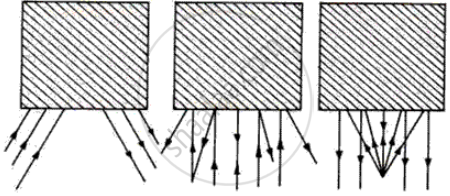
The boxes in figure (a, b, c) represent mirrors; insert a mirror which will reflect the incident ray as shown in the diagram.
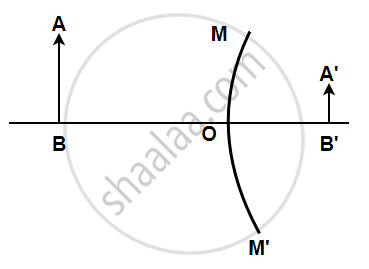
AB is the object, A1B1 is its image. MM' is the position of the mirror. Complete the ray diagram and find the position of the center of curvature and focus of the mirror. Also, measure the focal length.
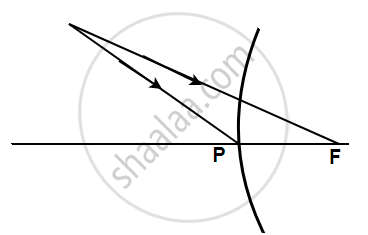
Complete the following diagrams shown in the following figures by drawing the reflected rays.
Define the term Principle focus.
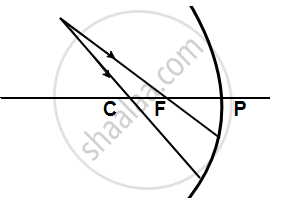
Complete the following diagrams shown in the below figure by drawing the reflected ray for each incident ray.
Define focal length.
If the real image of a candle flame formed by a lens is three times the size of the flame and the distance between lens and image is 80 cm, at what distance should the candle be placed from the lens?
Name the two types of spherical mirrors.
