Advertisements
Advertisements
प्रश्न
A ray of light is incident normally on a plane mirror. What will be the
angle of incidence?
Advertisements
उत्तर
The angle of incidence is 0o because the incident ray is parallel to the normal.
APPEARS IN
संबंधित प्रश्न
A simple microscope is used by watch repairers. Give reason.
Define the Focal length of a spherical mirror
The letter F is placed in front of a plane mirror:
What is the name of the phenomenon involved?
Complete the following sentence:
All the distances are measured from the .......... of a spherical mirror.
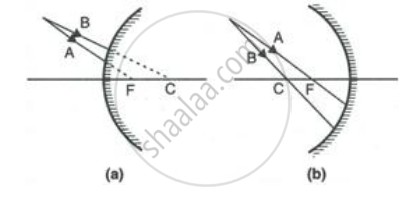
Complete the following diagrams shown in Fig. by drawing the reflected ray for each of the incident ray A and B.
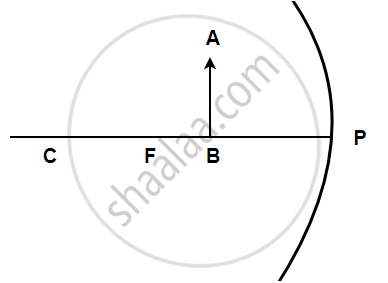
The diagram below in Figure, shows a convex mirror. C is its centre of curvature and F is its focus. (i) Draw two rays from A and hence locate the position of image of object OA. Label the image IB. (ii) State three characteristics of the image.
For what position of object, the image formed by a concave mirror is magnified and erect?
Define the term principal focus in case of convex mirror. Draw a convex mirror and show its principal focus and focal length clearly.
What is the relationship between the focal length and radius of curvature?
In the following figure shows a concave mirror with its pole (P), focus (F) and centre of curvature (C). Draw a ray diagram to show the formation of the image of an object AB by the concave mirror.
A concave mirror can be used to produce a parallel beam of light. Draw a ray to illustrate this.
The distance from the pole to the focus is called ______.
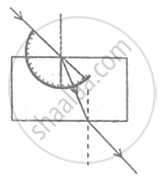
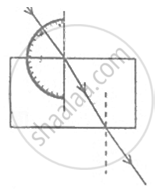
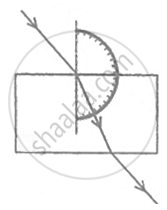
A student traces the path of a ray of light passing through a rectangular slab.
 |
 |
 |
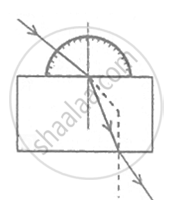 |
For measuring the angle of incidence, he must position the protractor in the manner shown in the figure:
An object is placed at a distance of 0.25 m
in front of a plane mirror. The distance between the object and image will be ______.
Name the type of mirror used in the following situation:
Side/rear-view mirror of a vehicle
Support your answer with reason.
For a spherical mirror, ______ is true.
What is the focal length (f) of a mirror?
What is “aperture”?
