Advertisements
Advertisements
प्रश्न
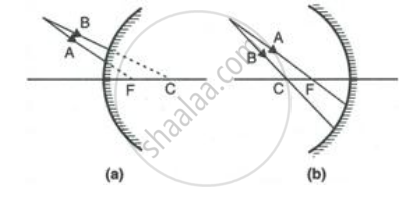
Complete the following diagrams shown in Fig. by drawing the reflected ray for each of the incident ray A and B.
Advertisements
उत्तर


APPEARS IN
संबंधित प्रश्न
A 4 cm tall object is placed on the principal axis of a convex lens. The distance of the object from the optical centre of the lens is 12 cm and its sharp image is formed at a distance of 24 cm from it on a screen on the other side of the lens. If the object is now moved a little away from the lens, in which way (towards the lens or away from the lens) will he have to move the screen to get a sharp image of the object on it again? How will the magnification of the image be affected?
Image formed by a convex ______ is always virtual and smaller in size.
- A small object is placed 150 mm away from a diverging lens of focal length 100 mm.
- Copy the figure below and draw rays to show how an image is formed by the lens.
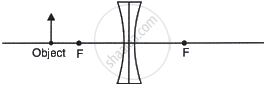
- Calculate the distance of the image from the lens by using the lens formula.
- Copy the figure below and draw rays to show how an image is formed by the lens.
- The diverging lens in part (a) is replaced by a converging lens also of focal length 100 mm. The object remains in the same position and an image is formed by the converging lens. Compare two properties of this image with those of the image formed by the diverging lens in part (a).
Write the spherical mirror's formula and explain the meaning of each symbol used in it.
Upto what maximum distance from a concave mirror, the image can be obtained? What will be the location of object for it?
A concave mirror forms a real image of an object placed in front of it at a distance 30 cm, of size three times the size of object. Find
- the focal length of mirror
- position of image.
The following Figure shows a concave mirror MM' on which a ray of light incident from a point P gets reflected to meet the principle axis at O.
(a) Find, by construction, the position of the centre of curvature of the concave mirror.
(b) Write down the value for the radius of curvature of the mirror.
(c) Calculate the focal length of the mirror.
(d ) Which relation is used in deducing the focal length from the radius of curvature?
In torches, search lights and headlights of vehicles the bulb is placed ______.
What is the difference between virtual images of an object formed by a concave mirror and a convex mirror?
