Advertisements
Advertisements
प्रश्न
- A small object is placed 150 mm away from a diverging lens of focal length 100 mm.
- Copy the figure below and draw rays to show how an image is formed by the lens.
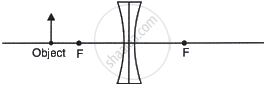
- Calculate the distance of the image from the lens by using the lens formula.
- Copy the figure below and draw rays to show how an image is formed by the lens.
- The diverging lens in part (a) is replaced by a converging lens also of focal length 100 mm. The object remains in the same position and an image is formed by the converging lens. Compare two properties of this image with those of the image formed by the diverging lens in part (a).
Advertisements
उत्तर
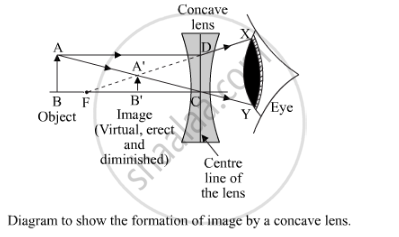
a. i. The image formed by the lens is virtual, erect and diminished in size.
ii. Object distance (u) = −150 mm = −15 cm (sign convention)
Focal length (f) = −100 mm = −10 cm (sign convention)
Image distance (v) = ?
By using the lens formula:
`1/v - 1/u = 1/f`
`1/v - 1/-15 = 1/-10`
`1/v + 1/15 = -1/10`
`1/v = 1/10-1/15`
`1/v = (-3-2)/30`
`1/v = (-5)/30`
v = −6 cm
b.
| Property | Image by diverging lens (Part a) | Image by converging lens (Part b) |
| Nature of image | Virtual and Erect (formed on the same side as the object) | Real and Inverted (formed on the opposite side of the lens) |
| Size/Magnification | Diminished (magnification is 0.4, making the image smaller) | Magnified / Enlarged (magnification is −2, making the image twice the size) |
APPEARS IN
संबंधित प्रश्न
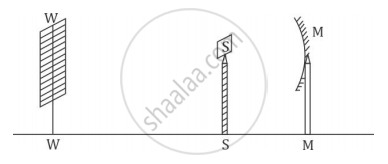
A student obtains a sharp image of the distant window (W) of the school laboratory on the screen (S) using the given concave mirror (M) to determine its focal length. Which of the following distances should he measure to get the focal length of the mirror?
Define the following term in the context of spherical mirrors:- Centre of curvature
Image formed by a convex ______ is always virtual and smaller in size.
What happens when a ray of light falls normally (or perpendiculary) on the surface of a plane mirror?
What type of image is formed:
on a cinema screen?
Name the two types of spherical mirrors. What type of mirror is represented by the:
front side of a shining steel spoon?
When a spherical mirror is held towards the sun and its sharp image is formed on a piece of carbon paper for some time, a hole is burnt in the carbon paper.
- What is the nature of spherical mirror?
- Why is a hole burnt in the carbon paper?
- At which point of the spherical mirror the carbon paper is placed?
- What name is given to the distance between spherical mirror and carbon paper?
- What is the advantage of using a carbon paper rather than a white paper?
Name the kind of mirror used to obtain
(a) a real and enlarged image
(b) a virtual and enlarged image
(c) a real and diminished image, and
(d) a virtual and diminished image.
State the number of images of an object placed between two mirrors, formed in each case when mirrors are inclined to each other at (a) 90°, and (b) 60°.
Define the terms pole, principal axis and centre of curvature with reference to a spherical mirror.
A real and enlarged image can be obtained by using a
An object of length 4 cm is placed in front of a concave mirror at distance 30 cm. The focal length of mirror is 15 cm.
- Where will the image form?
- What will be the length of image?
Define the following term in relation to concave mirror.
Aperture
What do you understand by the term real image?
The following Figure shows a concave mirror MM' on which a ray of light incident from a point P gets reflected to meet the principle axis at O.
(a) Find, by construction, the position of the centre of curvature of the concave mirror.
(b) Write down the value for the radius of curvature of the mirror.
(c) Calculate the focal length of the mirror.
(d ) Which relation is used in deducing the focal length from the radius of curvature?
In torches, search lights and headlights of vehicles the bulb is placed ______.
A shopkeeper wanted to fix a mirror which will give a maximum view of his shop. What type of mirror should he use? Give reason.
Visit a nearby hospital. You can also visit the clinic of an ENT specialist, or a dentist. Request the doctor to show you the mirrors used for examining ear, nose, throat and teeth. Can you recognise the kind of mirror used in these instruments?
