Advertisements
Advertisements
प्रश्न
When a spherical mirror is held towards the sun and its sharp image is formed on a piece of carbon paper for some time, a hole is burnt in the carbon paper.
- What is the nature of spherical mirror?
- Why is a hole burnt in the carbon paper?
- At which point of the spherical mirror the carbon paper is placed?
- What name is given to the distance between spherical mirror and carbon paper?
- What is the advantage of using a carbon paper rather than a white paper?
Advertisements
उत्तर
- The spherical mirror is concave.
- A lot of the sun’s heat rays are concentrated at the point of the sun’s image, which burns a hole in carbon paper.
- The carbon is placed at the focus.
- The distance between the spherical mirror and the carbon paper is named the focal length.
- A black carbon paper absorbs more heat rays and hence burns a hole more easily (than a white paper).
APPEARS IN
संबंधित प्रश्न
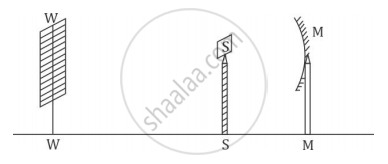
A student obtains a sharp image of the distant window (W) of the school laboratory on the screen (S) using the given concave mirror (M) to determine its focal length. Which of the following distances should he measure to get the focal length of the mirror?
Explain the following term related to spherical lenses:- optical centre
A student focused the Sun rays using an optical device 'X' on a screen S as shown.
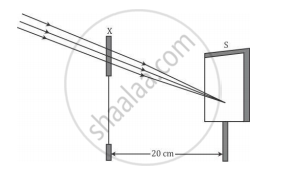
From this it may be concluded that the device 'X' is a (select the correct option)
(A) Convex lens of focal length 10 cm.
(B) Convex lens of radius of curvature 20 cm.
(C) Convex lens of focal length 20 cm.
(D) Concave mirror of focal length 20 cm.
Explain the following term related to spherical lenses:- centres of curvature
Draw separate diagram for the formation of virtual image of an object by a concave mirror.
Define the following terms in the context of spherical mirrors :
(i) Pole
(ii) Centre of curvature
(iii) Radius of curvature
(iv) Principal axis
What is a spherical mirror?
Name the two kinds of spherical mirrors and distinguish between them.
Name the kind of mirror used to obtain :
A real and enlarged image
The radius of curvature of a convex mirror is 40 cm. Find its focal length.
Define the following term in relation to concave mirror.
Principal focus
What is the relation between focal length and radius of curvature of a concave mirror?
Is real image always inverted?
Assertion: Incident ray is directed towards the centre of curvature of spherical mirror. After reflection it retraces its path.
Reason: Angle of incidence (i) = Angle of reflection (r) = 0°
What is the difference between virtual images of an object formed by a concave mirror and a convex mirror?
Visit a nearby hospital. You can also visit the clinic of an ENT specialist, or a dentist. Request the doctor to show you the mirrors used for examining ear, nose, throat and teeth. Can you recognise the kind of mirror used in these instruments?
