Advertisements
Advertisements
Question
When a spherical mirror is held towards the sun and its sharp image is formed on a piece of carbon paper for some time, a hole is burnt in the carbon paper.
- What is the nature of spherical mirror?
- Why is a hole burnt in the carbon paper?
- At which point of the spherical mirror the carbon paper is placed?
- What name is given to the distance between spherical mirror and carbon paper?
- What is the advantage of using a carbon paper rather than a white paper?
Advertisements
Solution
- The spherical mirror is concave.
- A lot of the sun’s heat rays are concentrated at the point of the sun’s image, which burns a hole in carbon paper.
- The carbon is placed at the focus.
- The distance between the spherical mirror and the carbon paper is named the focal length.
- A black carbon paper absorbs more heat rays and hence burns a hole more easily (than a white paper).
APPEARS IN
RELATED QUESTIONS
A simple microscope is used by watch repairers. Give reason.
A 4 cm tall object is placed on the principal axis of a convex lens. The distance of the object from the optical centre of the lens is 12 cm and its sharp image is formed at a distance of 24 cm from it on a screen on the other side of the lens. If the object is now moved a little away from the lens, in which way (towards the lens or away from the lens) will he have to move the screen to get a sharp image of the object on it again? How will the magnification of the image be affected?
A student focused the Sun rays using an optical device 'X' on a screen S as shown.
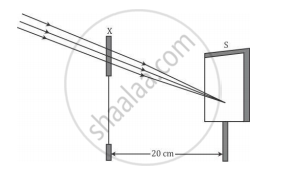
From this it may be concluded that the device 'X' is a (select the correct option)
(A) Convex lens of focal length 10 cm.
(B) Convex lens of radius of curvature 20 cm.
(C) Convex lens of focal length 20 cm.
(D) Concave mirror of focal length 20 cm.
Define the following term in the context of spherical mirrors:- Centre of curvature
Define (a) centre of curvature (b) radius of curvature (c) pole (d) principal axis, and (e) aperture, of a spherical mirror with the help of a labelled diagram
When a spherical mirror is held towards the sun and its sharp image is formed on a piece of a carbon paper for some time, a hole is burnt in the carbon paper.
What is the advantage of using a carbon paper rather than a white paper?
Write the formula for a lens connecting image distance (v), object distance (u) and the focal length (f). How does the lens formula differ from the mirror formula?
How is the focal length of a spherical mirror related to its radius
Name the kind of mirror used to obtain
(a) a real and enlarged image
(b) a virtual and enlarged image
(c) a real and diminished image, and
(d) a virtual and diminished image.
Three mirrors are created from a single sphere. Which of the following - pole, centre of curvature, radius of curvature, principal axis - will be common to them and which will not be common?
Explain the meaning of the terms focus and focal length in case of a convex mirror, with the help of suitable ray diagram.
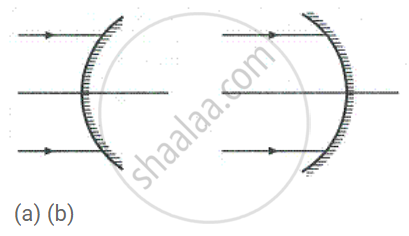
Name the mirrors shown in Figure (a) and (b).
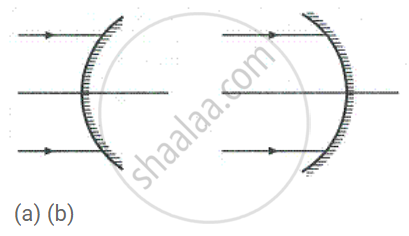
In each case (a) and (b), draw reflected rays for the given incident rays and mark focus by the symbol F.
Discuss the position and nature of image formed by a convex mirror when an object is moved from infinity towards the pole of mirror.
Define linear magnification produced by a mirror?
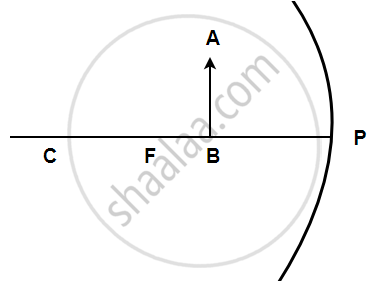
In the following figure shows a concave mirror with its pole (P), focus (F) and centre of curvature (C). Draw a ray diagram to show the formation of the image of an object AB by the concave mirror.
Define the term Centre of curvature.
A concave mirror can be used to produce a parallel beam of light. Draw a ray to illustrate this.
The spherical mirror used as a rear view mirror in the vehicle is
