Advertisements
Advertisements
Question
One half of a convex lens of focal length 10 cm is covered with a black paper. Can such a lens produce an image of a complete object placed at a distance of 30 cm from the lens? Draw a ray diagram to justify your answer. A 4 cm tall object is placed perpendicular to its principal axis of a convex lens of focal length 20 cm. The distance of the object from the lens is 15 cm. Find the nature, position and the size of the image.
Advertisements
Solution
An image is formed from a number of rays from the object getting refracted by the lens. The complete image will be formed even if one half of the lens is covered. However, the brightness of the image will be less.
Case I: When the upper half of the lens is covered
In this case, rays of light coming from the object get refracted by the lower half of the lens. These rays meet at the other side of the lens to form the image of the given object as shown in the following figure:
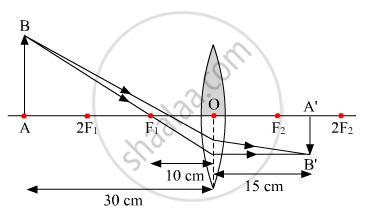
Case II: When the lower half of the lens is covered
A convex lens can produce the complete image of the object even though half of the lens is covered. This is because light coming from the object can be refracted from the other half of the lens. However, the intensity of light will be reduced.
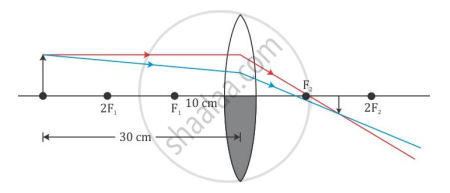
Given:-
Height of the object = h = 4 cm
Focal length of the convex lens = f = 20 cm
Object distance = u = −15 cm
Using the lens formula, we get
`1/`
`therefore1/`
`therefore`
Hence, the image is formed 60 cm in front of the lens on the same side as the object. Because v is negative, we can say that the image is virtual.
From the magnification formula for the lens, we get
`m=(h')/h=`
`thereforeh'=(`
Hence, the size of the image is h′ = 16 cm.
Because the height of the image is positive and greater than the height of the object, the image is erect and magnified.
So, we can conclude that the image is virtual, erect and magnified.
APPEARS IN
RELATED QUESTIONS
We can obtain a real, enlarged and inverted image by a concave mirror.
Which type of mirror can form a real image?
A ray of light is incident normally on a plane mirror. What will be the
angle of reflection?
Name the spherical mirror which can produce a real and diminished image of an object.
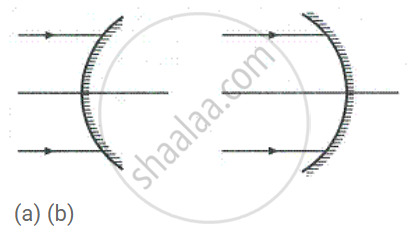
Name the mirrors shown in Figure (a) and (b).
When an object of height 1 cm is kept at a distance 4 cm from a concave mirror, its erect image of height 1.5 cm is formed at a distance 6 cm behind the mirror. Find the focal length of mirror, by drawing.
Answer the following question:
Distinguish between the convex mirror and the concave mirror.
In torches, search lights and headlights of vehicles the bulb is placed ______.
