Advertisements
Advertisements
Question
What is the name of the phenomenon in which the right side of an object appears to be the left side of the image in a plane mirror?
Advertisements
Solution
Lateral inversion is the phenomenon in which the right side of an object appears to be the left side in its image in a plane mirror.
APPEARS IN
RELATED QUESTIONS
A student focused the Sun rays using an optical device 'X' on a screen S as shown.
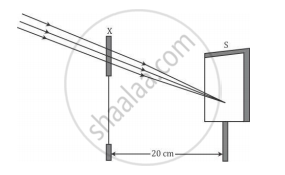
From this it may be concluded that the device 'X' is a (select the correct option)
(A) Convex lens of focal length 10 cm.
(B) Convex lens of radius of curvature 20 cm.
(C) Convex lens of focal length 20 cm.
(D) Concave mirror of focal length 20 cm.
Explain the following term related to spherical lenses:- principal axis
Explain the following term related to spherical lenses: focal length
What happens when a ray of light falls normally (or perpendiculary) on the surface of a plane mirror?
State the direction of incident ray which after reflection from a spherical mirror gets reflected along its own path. Give a reason.
Draw separate diagram for the formation of virtual image of an object by a concave mirror.
Draw a ray diagram to show the formation of image by a concave mirror for the object beyond its centre of curvature. State three characteristics of the image.
Name the kind of mirror used to obtain :
A real and enlarged image
Name the kind of mirror used to obtain:
A virtual and diminished image
An object of height 2 cm is placed at a distance of 20 cm in front of a concave mirror of a focal length of 12 cm. Find the position, size, and nature of the image.
An object forms a virtual image which is 1/8th of the size of the object. If the object is placed at a distance of 40 cm from the convex mirror, calculate:
- the position of the image
- the focal length of the convex mirror.
What is the relation between focal length and radius of curvature of a concave mirror?
Define the term Focus of a concave mirror.
An object is placed in front of a concave mirror as shown in the following figure. By scale drawing, find the nature of the image. Given f = 10 cm, v = 30 cm.
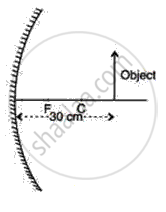
The spherical mirror with a reflecting surface curved inward is called
How tall does a mirror have to be to fit an entire person’s body?
Visit a nearby hospital. You can also visit the clinic of an ENT specialist, or a dentist. Request the doctor to show you the mirrors used for examining ear, nose, throat and teeth. Can you recognise the kind of mirror used in these instruments?
