Advertisements
Advertisements
Question
What kind of mirror is required for obtaining a virtual image of the same size as the object?
Advertisements
Solution
A plane mirror is required in order to obtain a virtual image of the same size as the object, as this is one of the properties of a plane mirror.
APPEARS IN
RELATED QUESTIONS
Explain the following term related to spherical lenses:- aperture
- A small object is placed 150 mm away from a diverging lens of focal length 100 mm.
- Copy the figure below and draw rays to show how an image is formed by the lens.
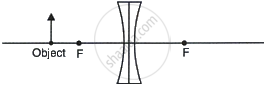
- Calculate the distance of the image from the lens by using the lens formula.
- Copy the figure below and draw rays to show how an image is formed by the lens.
- The diverging lens in part (a) is replaced by a converging lens also of focal length 100 mm. The object remains in the same position and an image is formed by the converging lens. Compare two properties of this image with those of the image formed by the diverging lens in part (a).
Draw separate diagram for the formation of virtual image of an object by a concave mirror.
A student obtained on a screen the sharp image of a candle flame placed at the farther end of laboratory table using a concave mirror. For getting better value of focal length of the mirror, the teacher suggested to him to focus the sun. What should the student do?
(A) Should move the mirror away from the screen.
(B) Should move the mirror towards the screen.
(C) Should move the mirror and screen both towards the sun.
(D) Should move only the screen towards the sun.
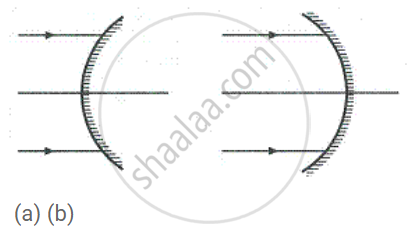
In each case (a) and (b), draw reflected rays for the given incident rays and mark focus by the symbol F.
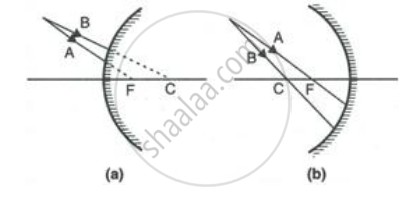
Complete the following diagrams shown in Fig. by drawing the reflected ray for each of the incident ray A and B.
Which mirror will you prefer to use as a rear view mirror in a car : plane mirror or convex mirror? Give one reason.
A concave mirror forms a virtual image of size twice that of the object placed at a distance 5 cm from it. Find:
- the focal length of the mirror
- position of image
Select the correct option:
A concave mirror is made by cutting a portion of a hollow glass sphere of radius 30 cm. The focal length of the concave mirror is:
Define the following term in relation to concave mirror.
Pole
What is the relation between focal length and radius of curvature of a concave mirror?
Define the term Focus of a concave mirror.
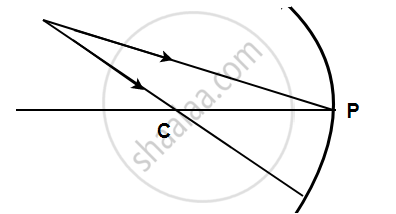
Complete the following diagrams shown in the following figures by drawing the reflected rays.
The distance from the pole to the focus is called ______.
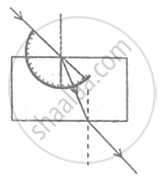
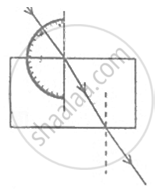
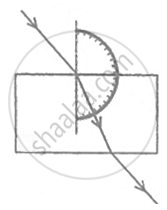
A student traces the path of a ray of light passing through a rectangular slab.
 |
 |
 |
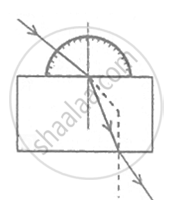 |
For measuring the angle of incidence, he must position the protractor in the manner shown in the figure:
The radius of curvature of a spherical mirror is 18 cm. What is the focal length of this mirror?
