Advertisements
Advertisements
प्रश्न
What is the name of the phenomenon in which the right side of an object appears to be the left side of the image in a plane mirror?
Advertisements
उत्तर
Lateral inversion is the phenomenon in which the right side of an object appears to be the left side in its image in a plane mirror.
APPEARS IN
संबंधित प्रश्न
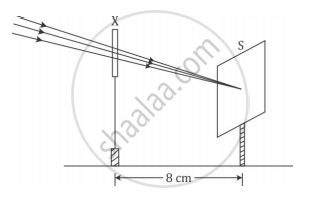
A student used a device (X) to obtain/focus the image of a well illuminated distant building on a screen (S) as shown below in the diagram. Select the correct statement about the device (X).
Write the formula for a lens connecting image distance (v), object distance (u) and the focal length (f). How does the lens formula differ from the mirror formula?
How is a spherical mirror used to converge a beam of light at a point? Name the type of mirror used.
State the direction of incident ray which after reflection from a spherical mirror gets reflected along its own path. Give a reason.
Which are the two convenient rays that are chosen to construct the image by a spherical mirror for a given object? Explain with the help of suitable ray diagrams.
Complete the following diagrams in Figure by drawing the reflected rays for the incident rays 1 and 2.
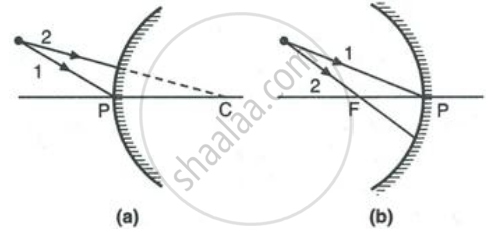
State whether the image in part (a) is real or virtual?
Write two more characteristics of the image.
Discuss the position and nature of image formed by a convex mirror when an object is moved from infinity towards the pole of mirror.
Define the following term in relation to concave mirror.
Radius of curvature
An object 10 cm high is placed at a distance of 20 cm in front of a spherical mirror of focal length 25 cm. By scale drawing find the nature, position, and magnification of the image in the following case:
Convex mirror
Define focal length.
In torches, search lights and headlights of vehicles the bulb is placed ______.
If the real image of a candle flame formed by a lens is three times the size of the flame and the distance between lens and image is 80 cm, at what distance should the candle be placed from the lens?
Name the type of mirror used in the following situation:
Side/rear-view mirror of a vehicle
Support your answer with reason.
Explain why a ray of light passing through the center of curvature of a concave mirror, gets reflected along with the same pattern.
