Advertisements
Advertisements
Questions
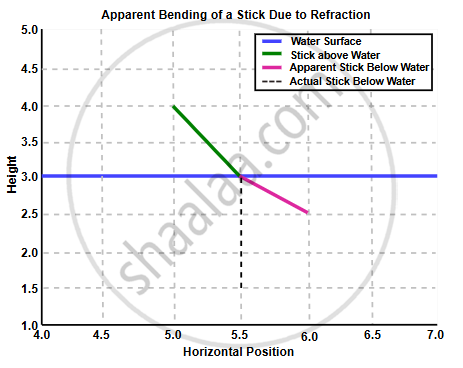
A straight stick partly dipped in water obliquely appears to be bent at the surface of the water.
A rod immersed partially and obliquely in water appears to be bent. Explain.
Advertisements
Solution 1
The phenomenon is due to refraction of light.
A ray of light OC coming from O passes from water into air and is refracted away from normal (along CX). Another ray, OD, gets refracted along with DY. The two refracted rays CX and DY, when produced backwards, appear to meet at the point I. Thus, I is the virtual image of the end O of the stick. Therefore, the stick appears to be bent as shown below.

Solution 2
- Light Refraction: When light passes from one medium (e.g., water) to another (e.g., air), it changes speed and direction. Light rays traveling from the submerged part of the stick (in water) to the observer's eyes (in air) bend away from normal at the water’s surface.
- Apparent Bending: Due to this bending of light, the part of the stick underwater appears shifted upward. As a result, the stick seems bent at the surface of the water, even though it is straight.
APPEARS IN
RELATED QUESTIONS
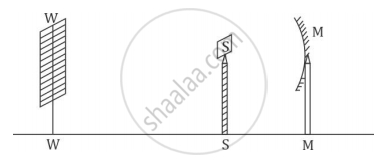
A student obtains a sharp image of the distant window (W) of the school laboratory on the screen (S) using the given concave mirror (M) to determine its focal length. Which of the following distances should he measure to get the focal length of the mirror?
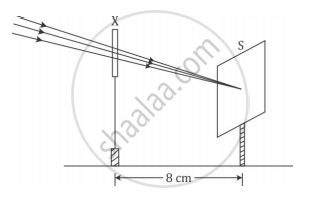
A student used a device (X) to obtain/focus the image of a well illuminated distant building on a screen (S) as shown below in the diagram. Select the correct statement about the device (X).
A 4 cm tall object is placed on the principal axis of a convex lens. The distance of the object from the optical centre of the lens is 12 cm and its sharp image is formed at a distance of 24 cm from it on a screen on the other side of the lens. If the object is now moved a little away from the lens, in which way (towards the lens or away from the lens) will he have to move the screen to get a sharp image of the object on it again? How will the magnification of the image be affected?
Define the following term in the context of spherical mirrors:- Centre of curvature
We can obtain a real, enlarged and inverted image by a concave mirror.
Mention the types of mirrors used as (i) rear view mirrors, (ii) shaving mirrors. List two reasons to justify your answers in each case.
Explain the following term:
Incident ray
Draw diagram/diagrams to show them.
Define the terms focus and focal length of a concave mirror. Draw diagram to illustrate your answer.
Figure shows a concave mirror with its pole at P, focus F and centre of curvature C. Draw ray diagram to show the formation of image of an object OA.
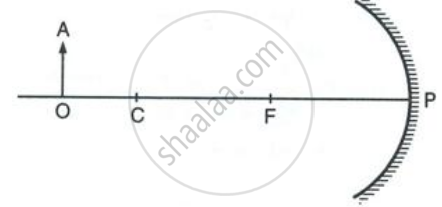
The diagram below in Figure, shows a convex mirror. C is its centre of curvature and F is its focus. (i) Draw two rays from A and hence locate the position of image of object OA. Label the image IB. (ii) State three characteristics of the image.
State the position of object for which the image formed by a concave mirror is of same size.
Answer the following question:
Distinguish between the convex mirror and the concave mirror.
Define the following term in relation to concave mirror.
Radius of curvature
What is a mirror formula?
The following Figure shows a concave mirror MM' on which a ray of light incident from a point P gets reflected to meet the principle axis at O.
(a) Find, by construction, the position of the centre of curvature of the concave mirror.
(b) Write down the value for the radius of curvature of the mirror.
(c) Calculate the focal length of the mirror.
(d ) Which relation is used in deducing the focal length from the radius of curvature?
A shopkeeper wanted to fix a mirror which will give a maximum view of his shop. What type of mirror should he use? Give reason.
The radius of curvature of a spherical mirror is 18 cm. What is the focal length of this mirror?
