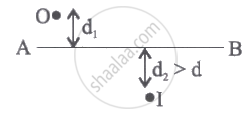
Advertisements
Advertisements
प्रश्न
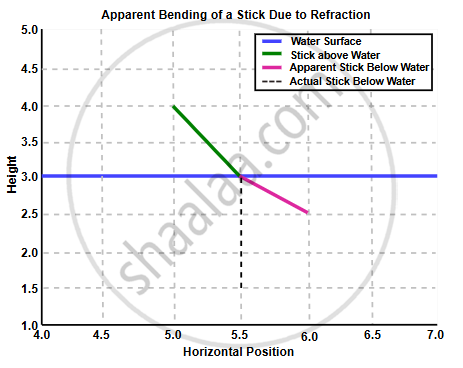
A straight stick partly dipped in water obliquely appears to be bent at the surface of the water.
A rod immersed partially and obliquely in water appears to be bent. Explain.
Advertisements
उत्तर १
The phenomenon is due to refraction of light.
A ray of light OC coming from O passes from water into air and is refracted away from normal (along CX). Another ray, OD, gets refracted along with DY. The two refracted rays CX and DY, when produced backwards, appear to meet at the point I. Thus, I is the virtual image of the end O of the stick. Therefore, the stick appears to be bent as shown below.

उत्तर २
- Light Refraction: When light passes from one medium (e.g., water) to another (e.g., air), it changes speed and direction. Light rays traveling from the submerged part of the stick (in water) to the observer's eyes (in air) bend away from normal at the water’s surface.
- Apparent Bending: Due to this bending of light, the part of the stick underwater appears shifted upward. As a result, the stick seems bent at the surface of the water, even though it is straight.
APPEARS IN
संबंधित प्रश्न
An image formed by a ______ mirror is always of the same size as that of the object.
A ray of light is incident on a plane mirror at an angle of 30°. What is the angle of reflection
When a spherical mirror is held towards the sun and its sharp image is formed on a piece of a carbon paper for some time, a hole is burnt in the carbon paper.
What name is given to the distance between spherical mirror and carbon paper?
Complete the following sentence:
All the distances are measured from the .......... of a spherical mirror.
The shiny outer surface of a hollow sphere of aluminium of radius 50 cm is to be used as a mirror:
- What will be the focal length of this mirror?
- Which type of spherical mirror will it provide?
- State whether this spherical mirror will diverge or converge light rays.
Which are the two convenient rays that are chosen to construct the image by a spherical mirror for a given object? Explain with the help of suitable ray diagrams.
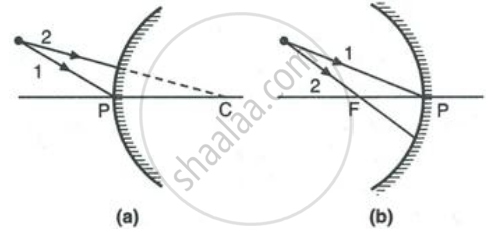
Complete the following diagrams in Figure by drawing the reflected rays for the incident rays 1 and 2.
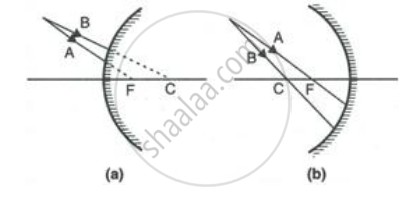
Complete the following diagrams shown in Fig. by drawing the reflected ray for each of the incident ray A and B.
For what position of object, the image formed by a concave mirror is magnified and erect?
Name the kind of mirror used to obtain:
A virtual and enlarged image
At what distance from a concave mirror of focal length 25 cm should an object be placed so that the size of image is equal to the size of the object.
An object is placed at 4 cm distance in front of a concave mirror of radius of curvature 24 cm. Find the position of image. Is the image magnified?
Define the following term:
spherical mirror
Complete the following diagrams shown in the following figures by drawing the reflected rays.
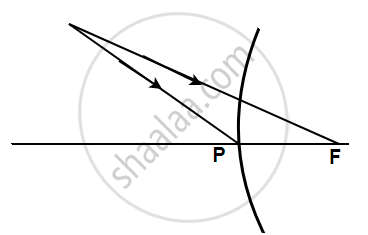
Draw a ray diagram to show that a convex mirror has a wider field of view.
Complete the following diagrams shown in the following figures by drawing the reflected rays.
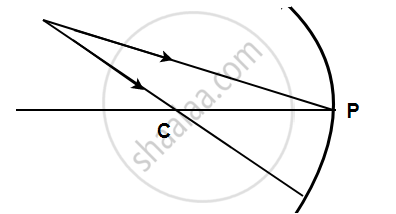
An object is placed at a distance of 0.25 m
in front of a plane mirror. The distance between the object and image will be ______.
Name the two types of spherical mirrors.
In the figure shown, the image of a real object is formed at the point I. AB is the principal axis of the mirror. The mirror must be: