Advertisements
Advertisements
प्रश्न
A coin placed at the bottom of a vessel appears to be raised when water is poured in the vessel.
Advertisements
उत्तर
The coin at a appears to be at B i. e. depth of coin observed is less than the actual depth at A.
The ray of light starting from A (denser) medium bends away from the normal. Due to the Refraction of light, the coin appears at B at a lower depth. Hence, in the same way, the depth of water appears to be less deep.

APPEARS IN
संबंधित प्रश्न
We can obtain a real, enlarged and inverted image by a concave mirror.
Three mirrors are created from a single sphere. Which of the following - pole, centre of curvature, radius of curvature, principal axis - will be common to them and which will not be common?
Draw a ray diagram to show the formation of image by a concave mirror for an object placed between its pole and focus. State three characteristics of the image.
Name the kind of mirror used to obtain :
A real and enlarged image
Name the kind of mirror used to obtain:
A virtual and diminished image
Which mirror will you prefer to use as a rear view mirror in a car : plane mirror or convex mirror? Give one reason.
The radius of curvature of a convex mirror is 40 cm. Find its focal length.
Define the following term:
concave mirror
Define the following term in relation to concave mirror.
Principal axis
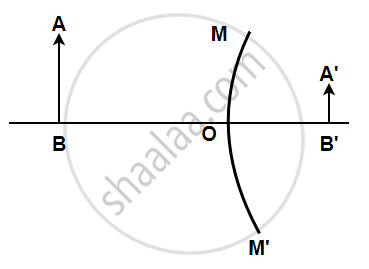
AB is the object, A1B1 is its image. MM' is the position of the mirror. Complete the ray diagram and find the position of the center of curvature and focus of the mirror. Also, measure the focal length.