Advertisements
Advertisements
प्रश्न
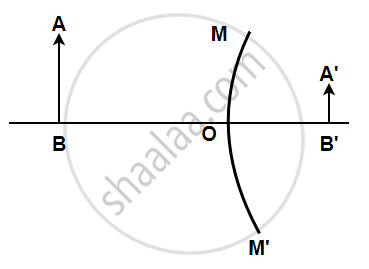
AB is the object, A1B1 is its image. MM' is the position of the mirror. Complete the ray diagram and find the position of the center of curvature and focus of the mirror. Also, measure the focal length.
Advertisements
उत्तर
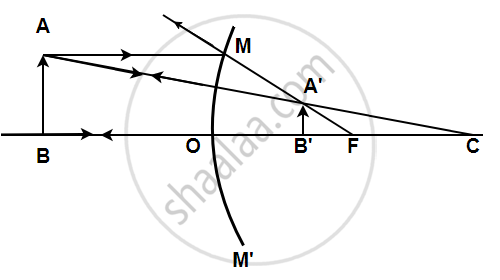
A light ray coming from a point on object AB is reflected from the surface of the mirror. When this ray is produced backwards, it passes through the principal focus and the ray which traces its incident path after reflection, when produced backwards, passes through the centre of curvature. These two reflected rays coincide at a point where the image is formed. The image, A'B' is virtual, erect, and diminished in size The focal length was found to be 24 mm.
APPEARS IN
संबंधित प्रश्न
When a spherical mirror is held towards the sun and its sharp image is formed on a piece of carbon paper for some time, a hole is burnt in the carbon paper.
- What is the nature of spherical mirror?
- Why is a hole burnt in the carbon paper?
- At which point of the spherical mirror the carbon paper is placed?
- What name is given to the distance between spherical mirror and carbon paper?
- What is the advantage of using a carbon paper rather than a white paper?
Write true or false
A virtual image formed by a spherical mirror is always erect and situated behind the mirror.
What is a spherical mirror?
The letters on the front of an ambulance are written laterally inverted like  . Give reason.
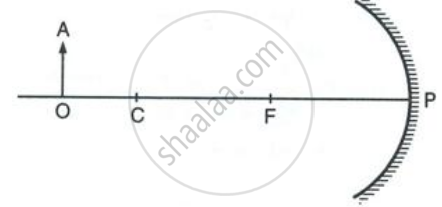
Figure shows a concave mirror with its pole at P, focus F and centre of curvature C. Draw ray diagram to show the formation of image of an object OA.
Which mirror will you prefer to use as a rear view mirror in a car : plane mirror or convex mirror? Give one reason.
An object 10 cm high is placed at a distance of 20 cm in front of a spherical mirror of focal length 25 cm. By scale drawing find the nature, position, and magnification of the image in the following case:
Convex mirror
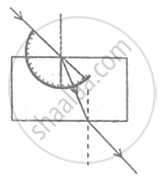
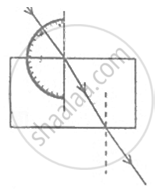
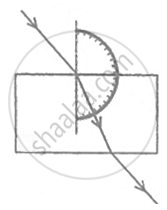
A student traces the path of a ray of light passing through a rectangular slab.
 |
 |
 |
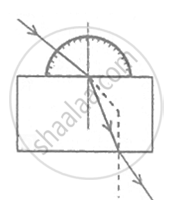 |
For measuring the angle of incidence, he must position the protractor in the manner shown in the figure:
Explain why a ray of light passing through the center of curvature of a concave mirror, gets reflected along with the same pattern.
