Advertisements
Advertisements
प्रश्न
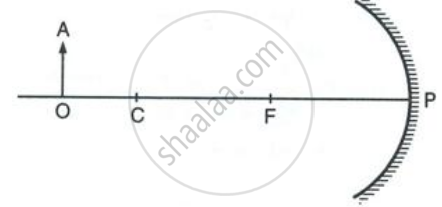
Figure shows a concave mirror with its pole at P, focus F and centre of curvature C. Draw ray diagram to show the formation of image of an object OA.
Advertisements
उत्तर

APPEARS IN
संबंधित प्रश्न
A virtual image larger than the object can be produced by a ______.
A ray of light is incident on a plane mirror at an angle of 30°. What is the angle of reflection
A ray of light strikes a plane mirror at an angle of 40° to the mirror surface. What will be the angle of reflection?
Name the spherical mirror which can produce a real and diminished image of an object.
A coin placed at the bottom of a vessel appears to be raised when water is poured in the vessel.
Answer the following question.
Write the modification in the curvature of the eye lens which enables us to see the nearby objects clearly?
Define the following term in relation to concave mirror.
Principal focus
A shopkeeper wanted to fix a mirror which will give a maximum view of his shop. What type of mirror should he use? Give reason.
Visit a nearby hospital. You can also visit the clinic of an ENT specialist, or a dentist. Request the doctor to show you the mirrors used for examining ear, nose, throat and teeth. Can you recognise the kind of mirror used in these instruments?
