Advertisements
Advertisements
प्रश्न
Answer the following question.
Write the modification in the curvature of the eye lens which enables us to see the nearby objects clearly?
Advertisements
उत्तर
There should be a contract in ciliary muscles, that will increase the curvature of the eye lens and becomes thicker consequently the focal length of the eye lens will decrease. It will enable us to see near objects clearly.
APPEARS IN
संबंधित प्रश्न
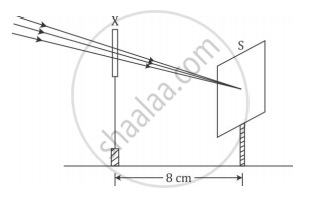
A student used a device (X) to obtain/focus the image of a well illuminated distant building on a screen (S) as shown below in the diagram. Select the correct statement about the device (X).
- A small object is placed 150 mm away from a diverging lens of focal length 100 mm.
- Copy the figure below and draw rays to show how an image is formed by the lens.
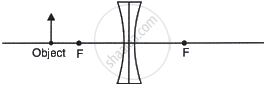
- Calculate the distance of the image from the lens by using the lens formula.
- Copy the figure below and draw rays to show how an image is formed by the lens.
- The diverging lens in part (a) is replaced by a converging lens also of focal length 100 mm. The object remains in the same position and an image is formed by the converging lens. Compare two properties of this image with those of the image formed by the diverging lens in part (a).
How is the focal length of a spherical mirror related to its radius
State the types of mirrors used for (i) headlights and (ii) rear view mirror, in cars and motorcycles. Give to justify your answer in each case.
The erect image formed by a concave mirror is of size double the size of object. How are u and v related?
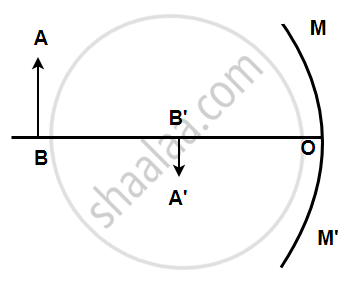
AB is the object, A'B' is the image, and MM' is the position of the mirror. Complete the ray diagram showing the formation of the image and find the focal length of the mirror.
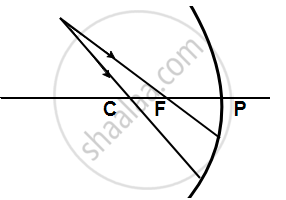
Complete the following diagrams shown in the below figure by drawing the reflected ray for each incident ray.
Define focal length.
What is the focal length (f) of a mirror?
Visit a nearby hospital. You can also visit the clinic of an ENT specialist, or a dentist. Request the doctor to show you the mirrors used for examining ear, nose, throat and teeth. Can you recognise the kind of mirror used in these instruments?
