Advertisements
Advertisements
प्रश्न
Answer the following question.
2 g of silver chloride is taken in a china dish and the china dish is placed in sunlight for some time. What will be your observation in this case? Write the chemical reaction involved in the form of a balanced chemical equation. Identify the type of chemical reaction.
Advertisements
उत्तर
When 2 g of silver chloride, AgCl, is kept in sunlight then AgCl breaks down into Ag and C12. The color of the silver chloride turns to grey.
The following change can be represented by the chemical reactions as:
\[\ce{2AgCl(s)->[sunlight] 2Ag(s) + Cl2(g)}\].
This type of reaction is an example of a photochemical decomposition reaction.
APPEARS IN
संबंधित प्रश्न
Write the balanced chemical equation for the following and identify the type of reaction.
\[\ce{Zinc carbonate(s) -> Zinc oxide(s) + Carbon dioxide(g)}\]
What type of reaction is represented by the following equation?
\[\ce{NH4NO2 -> N2 + 2H2O}\]
Classify the following reaction as combination, decomposition, displacement, precipitation and neutralization. Also balance the equation.
\[\ce{Zn_{(s)} + H2SO4 -> ZnSO4_{(s)} + H2_{(g)}}\]
Differentiate between direct combination reaction and a decomposition reaction.
Give a balanced equation for –
An electrolytic decomposition reaction involving a neutral liquid
Explain the reaction given in the figure.
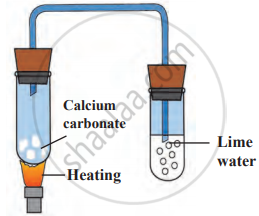
Balance the following chemical equation and identify the type of chemical reaction.
`"H"_2"O"_2("l") overset("U V")(->) "H"_2"O"("l") + "O"_2("g")`
These consist of two statements – Assertion (A) and Reason (R). Answer these questions selecting the appropriate option given below:
Assertion: Silver bromide decomposition is used in black and white photography.
Reason: Light provides energy for this exothermic reaction.

- Identify the gasses evolved at the anode and cathode in the above experimental set up.
- Name the process that occurs. Why is it called so?
- Illustrate the reaction of the process with the help of a chemical equation.
When lead nitrate is heated strongly in a boiling tube, two gases are liberated and a solid residue is left behind in the test tube.
- Name the type of chemical reaction and define it.
- Write the name and formula of the coloured gas liberated.
- Write the balanced chemical equation for the reaction.
- Name the residue left in the test tube and state the method of testing its nature (acidic/basic).
