Advertisements
Advertisements
प्रश्न
The erect image formed by a concave mirror is of size double the size of object. How are u and v related?
Advertisements
उत्तर
Magnification is
m = `"I"/"O" = 20/"O" = 2`
∵ m = `-"v"/"u"`
∴ `-"v"/"u"` = 2
∴ v = -2u
But , u is always negative
∴ v = 2u
APPEARS IN
संबंधित प्रश्न
Draw separate diagram for the formation of virtual image of an object by a concave mirror.
Draw a ray diagram to show the formation of image by a concave mirror for the object beyond its centre of curvature. State three characteristics of the image.
Draw a ray diagram to show the formation of image of an object kept in front of a convex mirror. State three characteristics of the image.
Select the correct option:
Looking into a mirror one finds her image diminished, the mirror is:
Does the mirror name by your form a real image for all locations? Give a reason for your answer.
Define the term Principle focus.
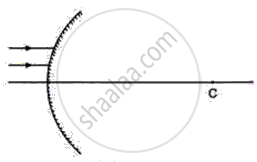
The diagram below shows the parallel rays incident on a convex mirror. C is the centre of the curvature of the mirror. By drawing the paths of the reflected rays, label the focus F and hence find the focal length of the mirror.
The minimum length of the mirror required to see the full image of the person is half ‘ of his height.
Visit a nearby hospital. You can also visit the clinic of an ENT specialist, or a dentist. Request the doctor to show you the mirrors used for examining ear, nose, throat and teeth. Can you recognise the kind of mirror used in these instruments?
