Advertisements
Advertisements
Question
The erect image formed by a concave mirror is of size double the size of object. How are u and v related?
Advertisements
Solution
Magnification is
m = `"I"/"O" = 20/"O" = 2`
∵ m = `-"v"/"u"`
∴ `-"v"/"u"` = 2
∴ v = -2u
But , u is always negative
∴ v = 2u
APPEARS IN
RELATED QUESTIONS
When a spherical mirror is held towards the sun and its sharp image is formed on a piece of carbon paper for some time, a hole is burnt in the carbon paper.
- What is the nature of spherical mirror?
- Why is a hole burnt in the carbon paper?
- At which point of the spherical mirror the carbon paper is placed?
- What name is given to the distance between spherical mirror and carbon paper?
- What is the advantage of using a carbon paper rather than a white paper?
Name the spherical mirror which can produce a real and diminished image of an object.
A student obtained on a screen the sharp image of a candle flame placed at the farther end of laboratory table using a concave mirror. For getting better value of focal length of the mirror, the teacher suggested to him to focus the sun. What should the student do?
(A) Should move the mirror away from the screen.
(B) Should move the mirror towards the screen.
(C) Should move the mirror and screen both towards the sun.
(D) Should move only the screen towards the sun.
For an incident ray directed towards centre of curvature of a spherical mirror the reflected ray:
An object of length 4 cm is placed in front of a concave mirror at distance 30 cm. The focal length of mirror is 15 cm.
- Where will the image form?
- What will be the length of image?
Define the following term in relation to concave mirror.
Center of curvature
Define the following term in relation to concave mirror.
Focal length
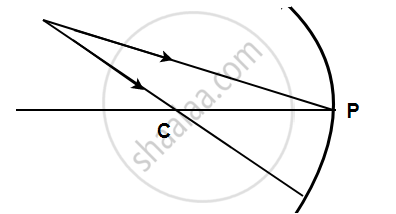
Complete the following diagrams shown in the following figures by drawing the reflected rays.
The spherical mirror with a reflecting surface curved inward is called
