Advertisements
Advertisements
Question
Explain the following terms :
Pole, Centre of curvature, Radius of curvature, Principal axis. Show them on separate diagrams for each of the concave and convex mirrors.
Advertisements
Solution
Pole: “The geometric centre of a spherical mirror is called POLE.”

Concave mirror Convex mirror
“The midpoint of aperture AB of the mirror is called pole.” P is pole of mirror.Centre of curvature: “The centre of a hollow sphere of which the mirror forms a part.” It is represented by the symbol ‘ C ‘
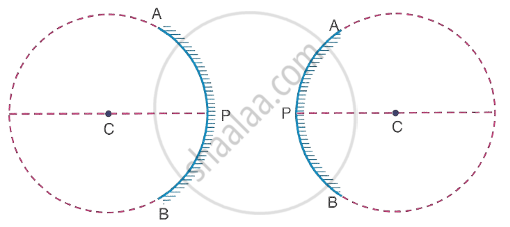
Concave mirror Convex mirror
Radius of curvature: “The radius of a hollow sphere of which the mirror is a part”. It is represented by ‘R’
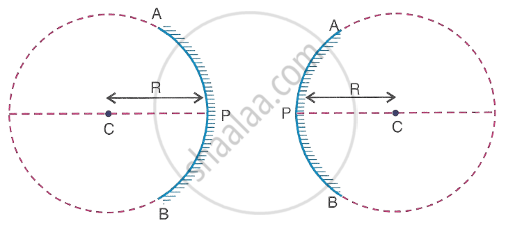
Concave mirror Convex mirror
Principal axis: “Is a straight line joining the pole of the mirror to its centre of curvature and extended further.”

Concave mirror Convex mirror
APPEARS IN
RELATED QUESTIONS
Find out the letters of English alphabet or any other language known to you in which the image formed in a plane mirror appears exactly like the letter itself. Discuss your findings.
When a spherical mirror is held towards the sun and its sharp image is formed on a piece of carbon paper for some time, a hole is burnt in the carbon paper.
- What is the nature of spherical mirror?
- Why is a hole burnt in the carbon paper?
- At which point of the spherical mirror the carbon paper is placed?
- What name is given to the distance between spherical mirror and carbon paper?
- What is the advantage of using a carbon paper rather than a white paper?
Define the terms pole, principal axis and centre of curvature with reference to a spherical mirror.
Which mirror will you prefer to use as a rear view mirror in a car : plane mirror or convex mirror? Give one reason.
What is the relation between focal length and radius of curvature of a concave mirror?
What is a mirror formula?
Define the term Principle focus.
A ray of light is incident towards a plane mirror at an angle of 30° with the mirror surface. What will be the angle of reflection?
For a spherical mirror, ______ is true.
A spherical mirror whose reflecting surface is curved outwards is called ______ mirror.
