हिंदी
सी.आई.एस.सी.ई.आईसीएसई ICSE Class 8

Explain the following terms : Pole, Centre of curvature, Radius of curvature, Principal axis. Show them on separate diagrams for each of the concave and convex mirrors

Advertisements
Advertisements

प्रश्न

Explain the following terms : 
Pole, Centre of curvature, Radius of curvature, Principal axis. Show them on separate diagrams for each of the concave and convex mirrors.

संक्षेप में उत्तर
आकृति
Advertisements

उत्तर

Pole: “The geometric centre of a spherical mirror is called POLE.”


         Concave mirror                                      Convex mirror

“The midpoint of aperture AB of the mirror is called pole.” P is pole of mirror.Centre of curvature: “The centre of a hollow sphere of which the mirror forms a part.” It is represented by the symbol ‘ C ‘
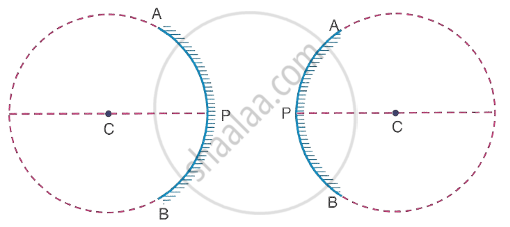

           Concave mirror                                      Convex mirror

Radius of curvature: “The radius of a hollow sphere of which the mirror is a part”. It is represented by ‘R’
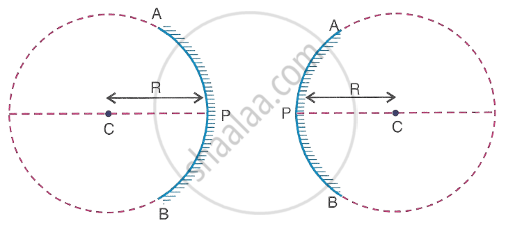

           Concave mirror                                     Convex mirror

Principal axis: “Is a straight line joining the pole of the mirror to its centre of curvature and extended further.”


           Concave mirror                                      Convex mirror

shaalaa.com
  क्या इस प्रश्न या उत्तर में कोई त्रुटि है?
अध्याय 5: Light Energy - Short/long Answer Question [पृष्ठ १००]

APPEARS IN

सेलिना Concise Physics [English] Class 8 ICSE
अध्याय 5 Light Energy
Short/long Answer Question | Q 26 | पृष्ठ १००

संबंधित प्रश्न

Define the following term in the context of spherical mirrors:- Principal focus


A concave mirror always forms a real image.


Match the items given in Column I with one or more items of Column II.

  Column I   Column II
(a) A plane mirror (i) Used as a magnifying glass.
(b) A convex mirror (ii) Can form image of objects spread over a large area.
(c) A convex lens (iii) Used by dentists to see enlarged image of teeth.
(d) A concave mirror (iv) The image is always inverted and magnified.
(e) A concave lens (v) The image is erect and of the same size as the object.
    (vi) The image is erect and smaller in size than the object.

When a spherical mirror is held towards the sun and its sharp image is formed on a piece of carbon paper for some time, a hole is burnt in the carbon paper.

  1. What is the nature of spherical mirror?
  2. Why is a hole burnt in the carbon paper?
  3. At which point of the spherical mirror the carbon paper is placed?
  4. What name is given to the distance between spherical mirror and carbon paper?
  5. What is the advantage of using a carbon paper rather than a white paper?

When a spherical mirror is held towards the sun and its sharp image is formed on a piece of a carbon paper for some time, a hole is burnt in the carbon paper. 

 What is the advantage of using a carbon paper rather than a white paper?


Write the mirror formula. Give the meaning of each symbol which occurs in it.


A student obtained a sharp image of a burning candle, placed at the farther end of a laboratory table, on a screen using a concave mirror. For getting better value of focal length of the mirror, the subject teacher suggested him for focusing a well illuminated distant object. What should the student do?

(A) He should move the mirror away from the screen.

(B) He should move the mirror slightly towards the screen.

(C) He should move the mirror as well as the screen towards the newly selected object.

(D) He should move only the screen towards the newly selected object.


Define the following term:

convex mirror


AB is the object, A'B' is the image, and MM' is the position of the mirror. Complete the ray diagram showing the formation of the image and find the focal length of the mirror.


Complete the following diagrams shown in the following figures by drawing the reflected rays.


Share
Notifications

Englishहिंदीमराठी


      Forgot password?
Use app×