Advertisements
Advertisements
प्रश्न
A ray of light strikes a plane mirror at an angle of 40° to the mirror surface. What will be the angle of reflection?
Advertisements
उत्तर
he angle of reflection is 500, in accordance with the first law of reflection, which states that the angle of incidence is equal to the angle of reflection.
Here, the angle of incidence = 90o - 40o = 50o( the angle of incidence is the angle between the incident ray and the normal).
APPEARS IN
संबंधित प्रश्न
Explain the following term related to spherical lenses:- optical centre
Explain the following term related to spherical lenses:- principal axis
Name the two types of spherical mirrors. What type of mirror is represented by the:
- back side of a shining steel spoon?
- front side of a shining steel spoon?
When a spherical mirror is held towards the sun and its sharp image is formed on a piece of a carbon paper for some time, a hole is burnt in the carbon paper.
What name is given to the distance between spherical mirror and carbon paper?
A coin placed at the bottom of a vessel appears to be raised when water is poured in the vessel.
State the kind of mirror used
(a) by a dentist, and
(b) as a street light reflector.
An optical device has been given to a student and he determines its focal length by focusing the image of the sun on a screen placed 24 cm from the device on the same side as the sun. Select the correct statement about the device.
(A) Convex mirror of focal length 12 cm
(B) Convex lens of focal length 24 cm
(C) Concave mirror of focal length 24 cm
(D) Convex lens of focal length 12 cm
Draw suitable diagrams to illustrate the action of (i) concave mirror and (ii) convex mirror on a beam of light incident parallel to the principal axis.
What type of mirror can be used to obtain a real image of an object?
Does the mirror mentioned in part (b) form real image for all locations of the object?
Which mirror will you prefer to use as a rear view mirror in a car : plane mirror or convex mirror? Give one reason.
The radius of curvature of a convex mirror is 40 cm. Find its focal length.
Define the term Normal.
Draw a ray diagram to show that a convex mirror has a wider field of view.
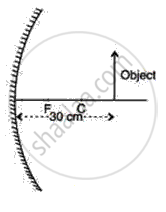
An object is placed in front of a concave mirror as shown in the following figure. By scale drawing, find the nature of the image. Given f = 10 cm, v = 30 cm.
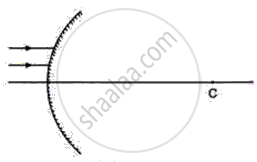
The diagram below shows the parallel rays incident on a convex mirror. C is the centre of the curvature of the mirror. By drawing the paths of the reflected rays, label the focus F and hence find the focal length of the mirror.
Geometric centre of the spherical mirror is ______.
The minimum length of the mirror required to see the full image of the person is half ‘ of his height.
