Advertisements
Advertisements
प्रश्न
A ray of light strikes a plane mirror at an angle of 40° to the mirror surface. What will be the angle of reflection?
Advertisements
उत्तर
he angle of reflection is 500, in accordance with the first law of reflection, which states that the angle of incidence is equal to the angle of reflection.
Here, the angle of incidence = 90o - 40o = 50o( the angle of incidence is the angle between the incident ray and the normal).
APPEARS IN
संबंधित प्रश्न
Define the Focal length of a spherical mirror
What is the name of the phenomenon in which the right side of an object appears to be the left side of the image in a plane mirror?
A ray of light travels from a denser medium to a rarer medium. How will it bend?
Define the following terms in the context of spherical mirrors :
(i) Pole
(ii) Centre of curvature
(iii) Radius of curvature
(iv) Principal axis
Draw a ray diagram to show the formation of image by a concave mirror for the object beyond its centre of curvature. State three characteristics of the image.
Choose the correct alternative and rewrite the following:
Mirror used by a dental surgeon is ..........................
An object 5 cm high forms a virtual image of 1.25 cm high, when placed in front of a convex mirror at a distance of 24 cm. Calculate:
- the position of the image
- the focal length of the convex mirror.
Select the correct option:
A mirror forms a virtual image (diminished) of an object, whatever be the position of object:
Define the following term in relation to concave mirror.
Radius of curvature
Define the term principal focus in case of convex mirror. Draw a convex mirror and show its principal focus and focal length clearly.
Find the height of the image of a body of height 1.5m in a mirror with a magnification of 1.5.
Complete the following diagrams shown in the below figure by drawing the reflected ray for each incident ray.
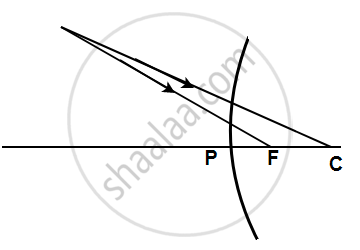
Define the term Centre of curvature.
A concave mirror can be used to produce a parallel beam of light. Draw a ray to illustrate this.
An object is placed at a distance of 0.25 m
in front of a plane mirror. The distance between the object and image will be ______.
A spherical mirror whose reflecting surface is curved outwards is called ______ mirror.
What is the focal length (f) of a mirror?
Define the radius of curvature.
