Advertisements
Advertisements
प्रश्न
A ray of light is incident on a plane mirror at an angle of 30°. What is the angle of reflection
Advertisements
उत्तर
The angle of reflection is 30⁰ as the angle of incidence is equal to the angle of reflection, in accordance with the first law of reflection.
APPEARS IN
संबंधित प्रश्न
A ray of light is incident normally on a plane mirror. What will be the
angle of reflection?
A 2.0 cm tall object is placed 40 cm from a diverging lens of focal length 15 cm. Find the position and size of the image.
What is a spherical mirror?
How is a spherical mirror used to diverge a beam of light from a point? Name the type of mirror used.
Name the two kinds of spherical mirrors and distinguish between them.
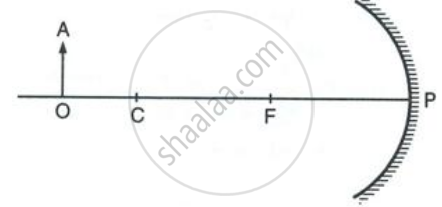
Figure shows a concave mirror with its pole at P, focus F and centre of curvature C. Draw ray diagram to show the formation of image of an object OA.
For an incident ray directed towards centre of curvature of a spherical mirror the reflected ray:
Select the correct option:
A mirror forms a virtual image (diminished) of an object, whatever be the position of object:
Define the following term in relation to concave mirror.
Principal axis
Define the term Aperture.
Define linear magnification produced by a mirror?
What is the relationship between the focal length and radius of curvature?
Define the term Normal.
The distance from the pole to the focus is called ______.
If the focal length of a spherical mirror is 10 cm, what is the value of its radius of curvature?
Geometric centre of the spherical mirror is ______.
