Advertisements
Advertisements
प्रश्न
What happens when a ray of light falls normally (or perpendiculary) on the surface of a plane mirror?
Advertisements
उत्तर
When a ray of light falls normally (or perpendicularly) on the surface of a plane mirror, it gets reflected along the same path because the angles of incidence and reflection are both equal to zero.
APPEARS IN
संबंधित प्रश्न
A 4 cm tall object is placed on the principal axis of a convex lens. The distance of the object from the optical centre of the lens is 12 cm and its sharp image is formed at a distance of 24 cm from it on a screen on the other side of the lens. If the object is now moved a little away from the lens, in which way (towards the lens or away from the lens) will he have to move the screen to get a sharp image of the object on it again? How will the magnification of the image be affected?
A student focused the Sun rays using an optical device 'X' on a screen S as shown.
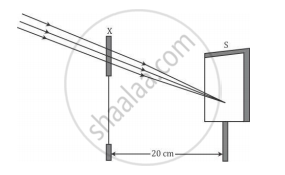
From this it may be concluded that the device 'X' is a (select the correct option)
(A) Convex lens of focal length 10 cm.
(B) Convex lens of radius of curvature 20 cm.
(C) Convex lens of focal length 20 cm.
(D) Concave mirror of focal length 20 cm.
Which type of mirror can form a real image?
A ray of light is incident on a plane mirror at an angle of 30°. What is the angle of reflection
What type of image is formed:
- in a plane mirror?
- on a cinema screen?
If a spherical mirror breaks, what type of mirrors are the individual pieces?
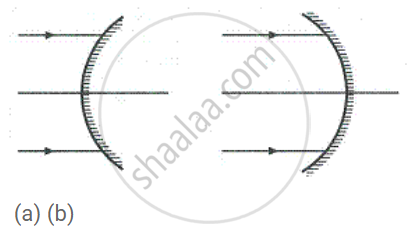
In each case (a) and (b), draw reflected rays for the given incident rays and mark focus by the symbol F.
A straight stick partly dipped in water obliquely appears to be bent at the surface of the water.
Choose the correct alternative and rewrite the following:
Mirror used by a dental surgeon is ..........................
Is real image always inverted?
What is a mirror formula?
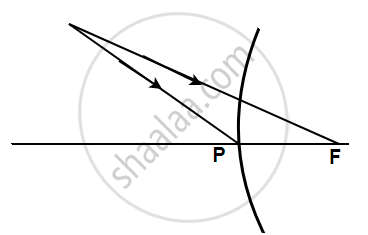
Complete the following diagrams shown in the following figures by drawing the reflected rays.
The spherical mirror with a reflecting surface curved inward is called
Size of image of an object by a mirror having a focal length of 20 cm is observed to be reduced to 1/3rd of its size. At what distance the object has been placed from the mirror? What is the nature of the image and the mirror?
A ray of light is incident towards a plane mirror at an angle of 30° with the mirror surface. What will be the angle of reflection?
How tall does a mirror have to be to fit an entire person’s body?
