Advertisements
Advertisements
Question
An object of height 2 cm is placed at a distance of 20 cm in front of a concave mirror of a focal length of 12 cm. Find the position, size, and nature of the image.
Advertisements
Solution 1

The image is 30 cm in front of the mirror, 3 cm high, real, inverted and magnified.
Solution 2
Object distance (u) = -20 cm
Focal length (f) = -12 cm
Image size (I) = 2 cm
Let the image distance be 'v' then
`1/u + 1/v = 1/f`
Or, `1/(-20) + 1/v = 1/(-12)`
Or, `1/v = -1/12 + 1/20 = (-5 + 3)/60`
Or, `1/v = -2/60`
Or, v = -30 cm
Now, `"Image size (I)"/"Object size (O)" = -"Image distnace (v)"/"Object distnace (u)"`
Or, `I/2 = -((-30)/-20)`
Or, I = -3 cm
∴ The image is 30 cm in front of the mirror.
The image is 3 cm high with the following characteristics:
- Real
- Inverted
- Magnified
APPEARS IN
RELATED QUESTIONS
A 4 cm tall object is placed on the principal axis of a convex lens. The distance of the object from the optical centre of the lens is 12 cm and its sharp image is formed at a distance of 24 cm from it on a screen on the other side of the lens. If the object is now moved a little away from the lens, in which way (towards the lens or away from the lens) will he have to move the screen to get a sharp image of the object on it again? How will the magnification of the image be affected?
Image formed by a convex ______ is always virtual and smaller in size.
Match the items given in Column I with one or more items of Column II.
| Column I | Column II | ||
| (a) | A plane mirror | (i) | Used as a magnifying glass. |
| (b) | A convex mirror | (ii) | Can form image of objects spread over a large area. |
| (c) | A convex lens | (iii) | Used by dentists to see enlarged image of teeth. |
| (d) | A concave mirror | (iv) | The image is always inverted and magnified. |
| (e) | A concave lens | (v) | The image is erect and of the same size as the object. |
| (vi) | The image is erect and smaller in size than the object. |
What type of image is formed:
on a cinema screen?
- A small object is placed 150 mm away from a diverging lens of focal length 100 mm.
- Copy the figure below and draw rays to show how an image is formed by the lens.
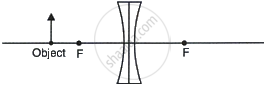
- Calculate the distance of the image from the lens by using the lens formula.
- Copy the figure below and draw rays to show how an image is formed by the lens.
- The diverging lens in part (a) is replaced by a converging lens also of focal length 100 mm. The object remains in the same position and an image is formed by the converging lens. Compare two properties of this image with those of the image formed by the diverging lens in part (a).
A student obtained on a screen the sharp image of a candle flame placed at the farther end of laboratory table using a concave mirror. For getting better value of focal length of the mirror, the teacher suggested to him to focus the sun. What should the student do?
(A) Should move the mirror away from the screen.
(B) Should move the mirror towards the screen.
(C) Should move the mirror and screen both towards the sun.
(D) Should move only the screen towards the sun.
An object 5 cm high is placed at a distance 60 cm in front of a concave mirror of focal length 10 cm. Find the position and size of the image.
Define the following term:
spherical mirror
The distance from the pole to the focus is called ______.
