Advertisements
Advertisements
Question
The focal length of a concave mirror is 10 cm. Find its radius of curvature.
Advertisements
Solution
Radius of curvature = 2 × focal length
Or, R = 2f = 2 × 10 = 20 cm
APPEARS IN
RELATED QUESTIONS
A ray of light is incident on a plane mirror at an angle of 30°. What is the angle of reflection
The letter F is placed in front of a plane mirror:
What is the name of the phenomenon involved?
The diverging lens in part (a) is replaced by a converging lens also of focal length 100 mm. The object remains in the same position and an image is formed by the converging lens. Compare two properties of this image with those of the image formed by the diverging lens in part (a).
State the kind of mirror used
(a) by a dentist, and
(b) as a street light reflector.
Explain the following term:
Incident ray
Draw diagram/diagrams to show them.
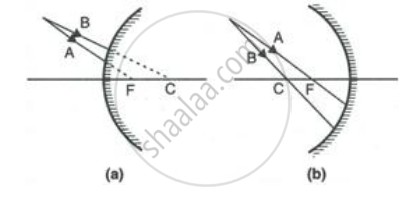
Complete the following diagrams shown in Fig. by drawing the reflected ray for each of the incident ray A and B.
The diagram below in Figure, shows a convex mirror. C is its centre of curvature and F is its focus. (i) Draw two rays from A and hence locate the position of image of object OA. Label the image IB. (ii) State three characteristics of the image.
How is the focal length of a spherical mirror related to its radius of curvature?
The erect image formed by a concave mirror is of size double the size of object. How are u and v related?
Draw a ray diagram to show that a convex mirror has a wider field of view.
