Advertisements
Advertisements
Question
Advertisements
Solution
Linear magnification is defined as the ratio of the height of the image to the height of the object. It is taken to be positive for an image to be virtual and erect and negative when the image is real and inverted.
Magnification produced by a concave mirror is:
Magnification = height of image / height of object.
It is a pure ratio and does not have any units.
APPEARS IN
RELATED QUESTIONS
A 4 cm tall object is placed on the principal axis of a convex lens. The distance of the object from the optical centre of the lens is 12 cm and its sharp image is formed at a distance of 24 cm from it on a screen on the other side of the lens. If the object is now moved a little away from the lens, in which way (towards the lens or away from the lens) will he have to move the screen to get a sharp image of the object on it again? How will the magnification of the image be affected?
Which type of mirror can form a real image?
A ray of light strikes a plane mirror at an angle of 40° to the mirror surface. What will be the angle of reflection?
The letter F is placed in front of a plane mirror:
What is the name of the phenomenon involved?
The shiny outer surface of a hollow sphere of aluminium of radius 50 cm is to be used as a mirror:
What will be the focal length of this mirror?
How is a spherical mirror used to converge a beam of light at a point? Name the type of mirror used.
An optical device has been given to a student and he determines its focal length by focusing the image of the sun on a screen placed 24 cm from the device on the same side as the sun. Select the correct statement about the device.
(A) Convex mirror of focal length 12 cm
(B) Convex lens of focal length 24 cm
(C) Concave mirror of focal length 24 cm
(D) Convex lens of focal length 12 cm
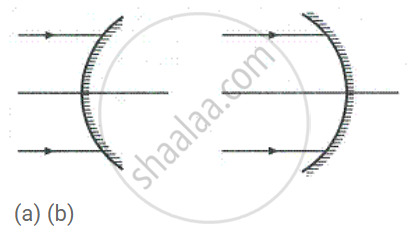
Name the mirrors shown in Figure (a) and (b).
The image formed by a convex mirror is of size one third the size of object. How are u and v related?
