Advertisements
Advertisements
प्रश्न
Advertisements
उत्तर
Linear magnification is defined as the ratio of the height of the image to the height of the object. It is taken to be positive for an image to be virtual and erect and negative when the image is real and inverted.
Magnification produced by a concave mirror is:
Magnification = height of image / height of object.
It is a pure ratio and does not have any units.
APPEARS IN
संबंधित प्रश्न
Match the items given in Column I with one or more items of Column II.
| Column I | Column II | ||
| (a) | A plane mirror | (i) | Used as a magnifying glass. |
| (b) | A convex mirror | (ii) | Can form image of objects spread over a large area. |
| (c) | A convex lens | (iii) | Used by dentists to see enlarged image of teeth. |
| (d) | A concave mirror | (iv) | The image is always inverted and magnified. |
| (e) | A concave lens | (v) | The image is erect and of the same size as the object. |
| (vi) | The image is erect and smaller in size than the object. |
State the direction of incident ray which after reflection from a spherical mirror gets reflected along its own path. Give a reason.
Name the mirror which always produces an erect and virtual image. How is the size of image related to the size of object?
State the position of object for which the image formed by a concave mirror is of same size.
The focal length of a concave mirror is 10 cm. Find its radius of curvature.
What is a mirror formula?
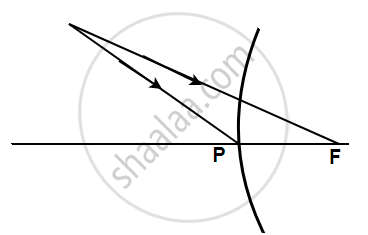
Complete the following diagrams shown in the following figures by drawing the reflected rays.
Geometric centre of the spherical mirror is ______.
