Advertisements
Advertisements
Question
An object is placed at 4 cm distance in front of a concave mirror of radius of curvature 24 cm. Find the position of image. Is the image magnified?
Advertisements
Solution
Given: u = - 4 cm, R = 24 cm, f = `"R"/2 = 24/2` = 12 cm (- ve)
`1/"v" = 1/"f" - 1/"u"`
`=> (- 1)/12 - ((- 1)/4)`
`=> (- 1)/12 + 1/4`
`=> (- 1 + 3)/12`
`=> 2/12`
`therefore 1/"v" = 1/6`
∴ v = 6 cm
Yes, the image is magnified.
m = `- "v"/"u" = (- 6)/(- 4) = 1.5`
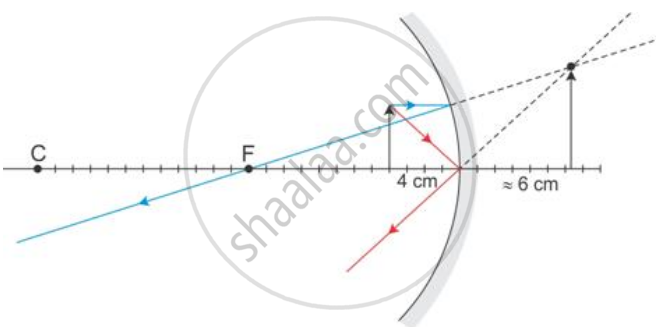
The image is 6 cm behind the mirror.
APPEARS IN
RELATED QUESTIONS
One half of a convex lens of focal length 10 cm is covered with a black paper. Can such a lens produce an image of a complete object placed at a distance of 30 cm from the lens? Draw a ray diagram to justify your answer. A 4 cm tall object is placed perpendicular to its principal axis of a convex lens of focal length 20 cm. The distance of the object from the lens is 15 cm. Find the nature, position and the size of the image.
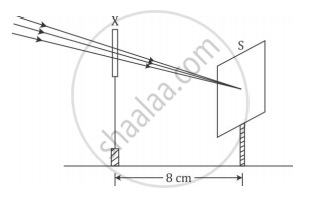
A student used a device (X) to obtain/focus the image of a well illuminated distant building on a screen (S) as shown below in the diagram. Select the correct statement about the device (X).
We can obtain an enlarged and erect image by a convex mirror.
Write two more characteristics of the image.
Select the correct option:
A mirror forms a virtual image (diminished) of an object, whatever be the position of object:
Define the following term:
spherical mirror
Draw a ray diagram to show that a convex mirror has a wider field of view.
A spherical mirror whose reflecting surface is curved outwards is called ______ mirror.
How tall does a mirror have to be to fit an entire person’s body?
