Advertisements
Advertisements
प्रश्न
An object is placed at 4 cm distance in front of a concave mirror of radius of curvature 24 cm. Find the position of image. Is the image magnified?
Advertisements
उत्तर
Given: u = - 4 cm, R = 24 cm, f = `"R"/2 = 24/2` = 12 cm (- ve)
`1/"v" = 1/"f" - 1/"u"`
`=> (- 1)/12 - ((- 1)/4)`
`=> (- 1)/12 + 1/4`
`=> (- 1 + 3)/12`
`=> 2/12`
`therefore 1/"v" = 1/6`
∴ v = 6 cm
Yes, the image is magnified.
m = `- "v"/"u" = (- 6)/(- 4) = 1.5`
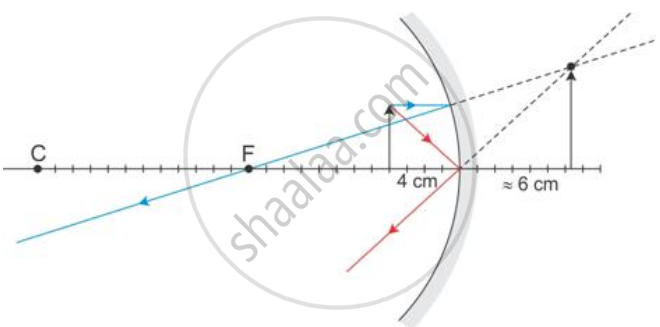
The image is 6 cm behind the mirror.
APPEARS IN
संबंधित प्रश्न
A 4 cm tall object is placed on the principal axis of a convex lens. The distance of the object from the optical centre of the lens is 12 cm and its sharp image is formed at a distance of 24 cm from it on a screen on the other side of the lens. If the object is now moved a little away from the lens, in which way (towards the lens or away from the lens) will he have to move the screen to get a sharp image of the object on it again? How will the magnification of the image be affected?
Explain the following term related to spherical lenses: focal length
Find out the letters of English alphabet or any other language known to you in which the image formed in a plane mirror appears exactly like the letter itself. Discuss your findings.
Define (a) centre of curvature (b) radius of curvature (c) pole (d) principal axis, and (e) aperture, of a spherical mirror with the help of a labelled diagram
A coin placed at the bottom of a vessel appears to be raised when water is poured in the vessel.
State the types of mirrors used for (i) headlights and (ii) rear view mirror, in cars and motorcycles. Give to justify your answer in each case.
Define the terms focus and focal length of a concave mirror. Draw diagram to illustrate your answer.
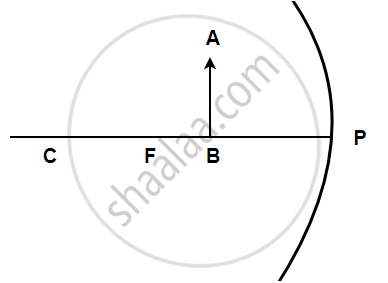
In the following figure shows a concave mirror with its pole (P), focus (F) and centre of curvature (C). Draw a ray diagram to show the formation of the image of an object AB by the concave mirror.
The image formed in a plane mirror is always inverted.
