Advertisements
Advertisements
Question
Advertisements
Solution
(i) The distance from the pole in the direction of incident ray is taken positive.
(ii) The distance from the pole in the direction opposite to the incident ray is taken negative.
APPEARS IN
RELATED QUESTIONS
Explain the following term related to spherical lenses:- aperture
Image formed by a convex ______ is always virtual and smaller in size.
What kind of mirror is required for obtaining a virtual image of the same size as the object?
How is a spherical mirror used to diverge a beam of light from a point? Name the type of mirror used.
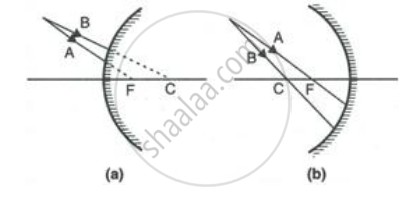
Complete the following diagrams shown in Fig. by drawing the reflected ray for each of the incident ray A and B.
Which mirror will you prefer to use as a rear view mirror in a car : plane mirror or convex mirror? Give one reason.
The magnification for a mirror is -3. How are u and v related?
Answer the following question.
Write the modification in the curvature of the eye lens which enables us to see the nearby objects clearly?
How tall does a mirror have to be to fit an entire person’s body?
In normal adjustment, for a refracting telescope, the distance between objective and eye piece is 30 cm. The focal length of the objective, when the angular magnification of the telescope is 2, will be ______.
