Advertisements
Advertisements
प्रश्न
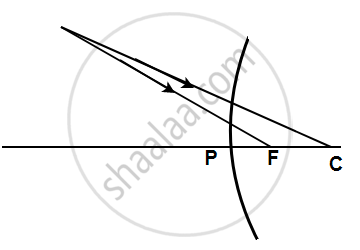
Draw a ray diagram to show the formation of image of an object kept in front of a convex mirror. State three characteristics of the image.
Advertisements
उत्तर

APPEARS IN
संबंधित प्रश्न
A student focused the Sun rays using an optical device 'X' on a screen S as shown.
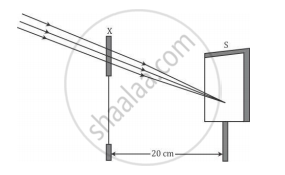
From this it may be concluded that the device 'X' is a (select the correct option)
(A) Convex lens of focal length 10 cm.
(B) Convex lens of radius of curvature 20 cm.
(C) Convex lens of focal length 20 cm.
(D) Concave mirror of focal length 20 cm.
Define the Focal length of a spherical mirror
A 2.0 cm tall object is placed 40 cm from a diverging lens of focal length 15 cm. Find the position and size of the image.
Write true or false
A virtual image formed by a spherical mirror is always erect and situated behind the mirror.
State the position of object for which the image formed by a concave mirror is of same size.
Upto what maximum distance from the pole the image in a convex mirror can be obtained? what will be the location of object then ?
A concave mirror forms a virtual image of size twice that of the object placed at a distance 5 cm from it. Find:
- the focal length of the mirror
- position of image
Define the following term in relation to concave mirror.
Principal focus
Complete the following diagrams shown in the below figure by drawing the reflected ray for each incident ray.