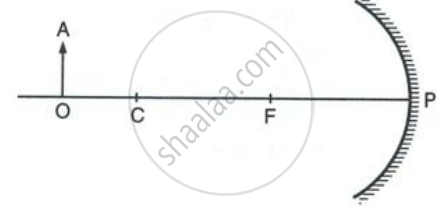
Figure Shows a Concave Mirror with Its Pole at P, Focus F and Centre of Curvature C. Draw Ray Diagram to Show the Formation of Image of an Object Oa.
Advertisements
प्रश्न
Figure shows a concave mirror with its pole at P, focus F and centre of curvature C. Draw ray diagram to show the formation of image of an object OA.
Advertisements

APPEARS IN
संबंधित प्रश्न
A simple microscope is used by watch repairers. Give reason.
We can obtain a real, enlarged and inverted image by a concave mirror.
Match the items given in Column I with one or more items of Column II.
| Column I | Column II | ||
| (a) | A plane mirror | (i) | Used as a magnifying glass. |
| (b) | A convex mirror | (ii) | Can form image of objects spread over a large area. |
| (c) | A convex lens | (iii) | Used by dentists to see enlarged image of teeth. |
| (d) | A concave mirror | (iv) | The image is always inverted and magnified. |
| (e) | A concave lens | (v) | The image is erect and of the same size as the object. |
| (vi) | The image is erect and smaller in size than the object. |
The shiny outer surface of a hollow sphere of aluminium of radius 50 cm is to be used as a mirror:
What will be the focal length of this mirror?
What do you understand by the focus and focal length of a spherical mirror? Show them on the separate diagrams for each of a concave mirror and a convex mirror.
Discuss the position and nature of image formed by a convex mirror when an object is moved from infinity towards the pole of mirror.
What is the relationship between the focal length and radius of curvature?
Assertion: Incident ray is directed towards the centre of curvature of spherical mirror. After reflection it retraces its path.
Reason: Angle of incidence (i) = Angle of reflection (r) = 0°
