Advertisements
Advertisements
प्रश्न
Match the items given in Column I with one or more items of Column II.
| Column I | Column II | ||
| (a) | A plane mirror | (i) | Used as a magnifying glass. |
| (b) | A convex mirror | (ii) | Can form image of objects spread over a large area. |
| (c) | A convex lens | (iii) | Used by dentists to see enlarged image of teeth. |
| (d) | A concave mirror | (iv) | The image is always inverted and magnified. |
| (e) | A concave lens | (v) | The image is erect and of the same size as the object. |
| (vi) | The image is erect and smaller in size than the object. |
Advertisements
उत्तर
| Column I | Column II | ||
| (a) | A plane mirror | (v) | The image is erect and of the same size as the object |
| (b) | A convex mirror | (ii) | Can form image of objects spread over a large area. |
| (vi) | The image is erect and smaller in size than the object. | ||
| (c) | A convex lens | (i) | Used as a magnifying glass. |
| (d) | A concave mirror | (iii) | Used by dentists to see enlarged image of teeth. |
| (e) | A concave lens | (vi) | The image is erect and smaller in size than the object. |
APPEARS IN
संबंधित प्रश्न
We can obtain an enlarged and erect image by a convex mirror.
The letter F is placed in front of a plane mirror:
What is the name of the phenomenon involved?
Name the two types of spherical mirrors. What type of mirror is represented by the:
front side of a shining steel spoon?
Name the spherical mirror which can produce a real and diminished image of an object.
Write two more characteristics of the image.
What is meant by magnification? Write its expression. What is its sign for the (a) real (b) virtual, image?
Define the term Aperture.
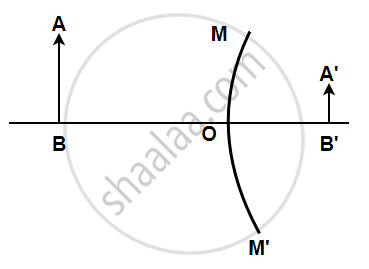
AB is the object, A1B1 is its image. MM' is the position of the mirror. Complete the ray diagram and find the position of the center of curvature and focus of the mirror. Also, measure the focal length.
Which of the following has curved reflecting surface?
